

Collagen is the most abundant protein in your body, and its role in skin tightening is far more nuanced than most supplement marketing would have you believe. Clinically, the correct term is dermal extracellular matrix remodelling, and it describes a gradual biological process rather than an instant lift. If you have noticed your skin feeling looser after weight loss, during menopause, or simply with age, understanding what collagen actually does, and what it cannot do, is the first step towards making genuinely informed choices about your skin.
Table of Contents
- Key takeaways
- The role of collagen in skin tightening
- What the science says about collagen supplements
- Why collagen loss is harder to reverse than to prevent
- Collagen supplements versus other approaches
- How to use collagen supplements effectively
- My honest take on collagen and skin tightening
- How Elastikskin supports your skin through change
- FAQ
Key takeaways
| Point | Details |
|---|---|
| Collagen builds skin structure | Type I and III collagen form the dermal scaffold that keeps skin firm and resilient. |
| Supplements work gradually | Clinical improvements in elasticity and hydration take at least 8 to 12 weeks of consistent daily use. |
| Dose and source matter | Marine collagen peptides at 5 to 10 g per day show the strongest evidence for measurable skin benefits. |
| Supplements are supportive, not curative | Collagen supplementation works best alongside topical treatments and professional procedures, not instead of them. |
| Lifestyle factors accelerate collagen loss | Sun exposure, smoking, weight fluctuation, and hormonal shifts all degrade collagen faster than ageing alone. |
The role of collagen in skin tightening
Collagen is not a single substance. Your skin relies primarily on two types: Type I, which provides tensile strength and makes up roughly 80 to 90 percent of dermal collagen, and Type III, which contributes flexibility and is particularly abundant in younger skin. Together, they form a dense, interwoven network within the dermis, the layer of skin beneath the surface, that gives skin its firmness and resistance to sagging.
This network sits within what scientists call the dermal extracellular matrix. Think of it as scaffolding. When the scaffolding is dense and well-organised, skin sits taut against the underlying tissue. When it degrades or thins, skin loses its ability to spring back, and you see the visible signs: fine lines, crepey texture, and laxity.
Several factors directly affect how well this scaffolding holds up:
- Age. Collagen production declines from your mid-twenties onwards, with accelerating loss after menopause in women.
- UV exposure. Ultraviolet radiation activates enzymes called matrix metalloproteinases that actively break down collagen fibres.
- Smoking. Tobacco reduces collagen synthesis and impairs the skin’s repair mechanisms.
- Rapid weight loss. When fat volume beneath the skin decreases quickly, the collagen network does not contract at the same rate, leaving skin appearing loose.
- Hormonal shifts. Oestrogen supports collagen synthesis; its decline during perimenopause and menopause directly reduces dermal collagen density and skin elasticity.
Understanding these mechanisms matters because it shapes realistic expectations. Collagen loss is multifactorial, and no single intervention reverses all of it.
What the science says about collagen supplements
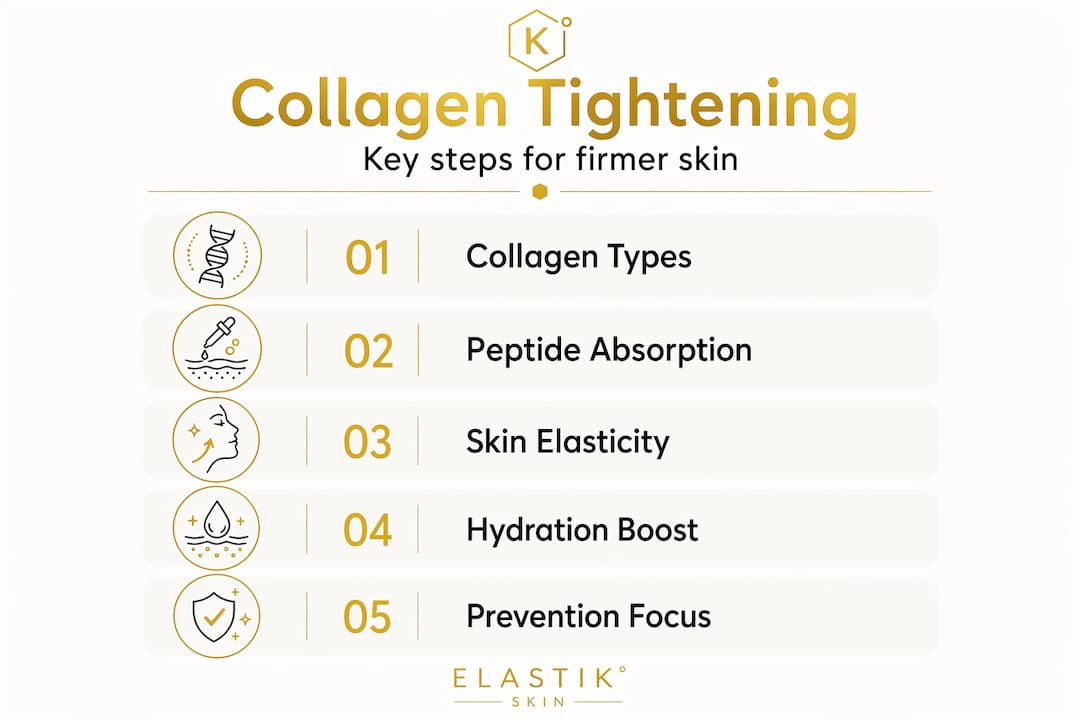
The clinical evidence for oral collagen supplementation has grown substantially in recent years, and the picture is genuinely encouraging, with important caveats.
A 2026 randomised controlled trial found that 12 weeks of bioactive collagen peptides significantly reduced facial wrinkles and improved both skin elasticity and hydration in women aged 35 to 55. Notably, effects were dose-dependent: participants taking 10 g per day showed greater improvements than those on 2.5 g per day. The study also recorded increases in systemic biomarkers TGF-β and Klotho, proteins associated with tissue repair and anti-ageing pathways, suggesting that collagen peptides may act beyond the skin itself.
A large evidence synthesis involving nearly 8,000 participants across 113 trials confirmed that daily collagen supplementation can improve skin elasticity and hydration over time. The researchers were clear, though: collagen does not provide immediate wrinkle removal or visible lifting. Its best use is steady, long-term maintenance.

The mechanism behind these effects is now better understood. Collagen peptides absorbed through the gut travel systemically and activate dermal fibroblasts, the cells responsible for producing new collagen and elastin. They also reduce the activity of collagen-degrading enzymes. This explains why results build gradually over weeks rather than appearing overnight. Radioactive-labelling studies have shown that oral collagen peptides remain in skin for over two weeks after ingestion, supporting the idea of a sustained dermal effect.
It is also worth noting what clinical trials actually measure. Skin viscoelasticity and hydration are the primary outcomes in most studies, not the kind of dramatic tensile tightening you would see from a device-based procedure. The improvements are real and measurable, but they are incremental.
Pro Tip: Look for studies that are independent of supplement manufacturers when evaluating collagen research. Industry-sponsored trials are common in this space, and while not automatically invalid, they warrant additional scrutiny.
| Study type | Key finding | Timeframe |
|---|---|---|
| 2026 RCT (35 to 55 year olds) | Improved elasticity, hydration, wrinkle reduction | 12 weeks |
| 113-trial evidence synthesis | Improved elasticity and hydration; no instant lifting | Ongoing daily use |
| Bioavailability studies | Peptides retained in skin tissue after oral ingestion | 2 weeks post-dose |
| Fibroblast activation research | Reduced collagen-degrading enzyme activity | Weeks of supplementation |
Why collagen loss is harder to reverse than to prevent
The honest truth about collagen production and ageing is that prevention is significantly more effective than restoration. Once collagen fibres degrade and the dermal matrix thins, rebuilding it is a slow process, and supplementation alone is rarely sufficient to fully reverse visible laxity.
For people who have experienced significant weight loss, this is particularly relevant. The skin’s collagen network adapts to body volume over time, but rapid changes do not give it enough time to remodel. The result is loose, crepey skin that reflects a structural deficit rather than a surface issue. Similarly, the hormonal shifts of menopause can cause a substantial reduction in skin collagen within the first few years, producing noticeable changes in firmness and texture.
This does not mean supplementation is futile. It means framing it correctly:
- Collagen supplements are most effective as a maintenance strategy, slowing further loss and supporting the skin’s repair processes.
- They are not a substitute for topical treatments, professional procedures, or lifestyle measures that address collagen degradation at the source.
- Results require patience and consistency. Eight to twelve weeks is the minimum before expecting measurable change, and many people see the most benefit at six months or beyond.
The supplement industry does not always communicate this clearly. Products marketed with before-and-after photographs taken weeks apart are rarely showing you the effects of collagen supplementation alone.
Collagen supplements versus other approaches
Understanding where oral collagen sits relative to other skin-tightening methods helps you build a genuinely effective routine rather than relying on a single solution.
Topical retinoids and peptides are among the most evidence-backed options for stimulating collagen directly in the dermis. Retinoids increase cell turnover and upregulate collagen synthesis; peptides signal fibroblasts to produce more structural proteins. Both work at the site where you need them most. Topical retinoids and peptides stimulate collagen more directly than oral supplementation, producing faster and more noticeable tightening in many cases.
Professional procedures such as microneedling and laser resurfacing create controlled micro-injuries that trigger a wound-healing response, driving significant collagen remodelling. These produce more dramatic results than supplements, but they require downtime, professional oversight, and ongoing investment. An LED face and neck mask using red light therapy offers a home-based alternative that stimulates fibroblast activity without the recovery period of clinical procedures.
Lifestyle measures remain underestimated. Consistent SPF use is arguably the single most effective collagen-preservation strategy available. Adequate hydration, a diet rich in vitamin C and zinc (both cofactors in collagen synthesis), and avoiding smoking all support the skin’s ability to produce and maintain collagen.
| Approach | Benefit | Limitation | Timeframe |
|---|---|---|---|
| Oral collagen peptides | Systemic support, hydration, elasticity | Gradual; not curative for laxity | 8 to 12 weeks minimum |
| Topical retinoids/peptides | Direct dermal collagen stimulation | Requires consistent daily use | 4 to 8 weeks |
| Microneedling/laser | Significant remodelling, visible tightening | Cost, downtime, professional access | 1 to 3 sessions |
| Red light therapy | Fibroblast activation, accessible at home | Less dramatic than clinical procedures | 4 to 8 weeks |
| Sun protection and nutrition | Prevents further collagen degradation | Preventive rather than restorative | Ongoing |
Pro Tip: Combining oral collagen peptides with a topical peptide serum gives you both systemic and localised fibroblast support simultaneously. The two approaches are genuinely complementary, not redundant.
How to use collagen supplements effectively
If you decide to add collagen supplementation to your routine, a few practical principles significantly affect whether you see results.
- Choose hydrolysed collagen peptides. These are broken down into smaller fragments that the body absorbs more readily than whole collagen protein. Marine collagen with low molecular weight peptides shows higher systemic bioavailability than typical bovine sources, making it a stronger choice for skin-specific goals.
- Dose at 5 to 10 g per day. The evidence consistently clusters around this range. Lower doses may offer some benefit, but the most significant improvements in elasticity and wrinkle reduction appear at doses of 10 g per day sustained over at least 12 weeks.
- Take it with vitamin C. Vitamin C is a required cofactor for collagen synthesis. Taking your supplement alongside a vitamin C-rich food or a dedicated supplement supports the body’s ability to use the peptides effectively.
- Set a realistic timeline. Mark your calendar for 12 weeks before assessing results. Photograph your skin in consistent lighting at the start and at the 8 and 12-week marks to track genuine change rather than relying on day-to-day perception.
- Pair with a topical routine. A collagen architect serum or peptide-based product used alongside oral supplementation addresses both systemic and localised collagen support, which is where the most meaningful results tend to come from.
- Seek professional advice if laxity is significant. If your skin looseness is substantial, particularly following major weight loss or hormonal changes, a dermatologist can assess whether procedural interventions would be more appropriate as a starting point.
My honest take on collagen and skin tightening
I lost over 126 pounds, and I can tell you from direct experience that the skin changes that come with significant weight loss are not something a collagen supplement alone will fix. I tried several before I understood what the research actually says, and what it does not say.
What I have learned is that collagen supplementation is genuinely useful, but only when you stop expecting it to be a shortcut. The studies showing real improvements in elasticity and hydration are credible. The mechanisms are plausible. But the marketing around collagen products often implies a speed and magnitude of change that the evidence simply does not support.
The approach that actually made a difference for me was treating collagen supplements as one layer of a broader routine. Oral peptides for systemic support. Topical actives for direct dermal stimulation. Sun protection every single day. And products specifically formulated for skin that has been through a transformation, not products designed for someone who just wants to look a little fresher.
I also think the framing of “skin tightening” sets people up for disappointment. What collagen supplementation does well is improve skin quality: hydration, resilience, texture, and the gradual slowing of further loss. That is genuinely worth having. It just requires patience and a realistic understanding of what you are working with.
— Marc
How Elastikskin supports your skin through change
If your skin has been through a transformation, whether from weight loss, hormonal shifts, or simply the passage of time, the right products make a measurable difference. Elastikskin was built specifically for this. Not for people who want a quick fix, but for people who want science-backed support for skin that is actively changing.
The Resilience Matrix Night Cream works overnight to support the skin barrier and improve elasticity, while the LED Face and Neck Mask uses red light therapy to stimulate fibroblast activity and collagen production directly. For those dealing with loose skin after weight loss, the dedicated loose skin guidance page offers targeted advice on combining supplementation, topical care, and professional options for the best possible outcome. Every product in the range is formulated with the specific challenges of transforming skin in mind.
FAQ
What does collagen actually do for skin firmness?
Collagen forms the structural scaffolding of the dermis, giving skin its tensile strength and resistance to sagging. When collagen density is high, skin sits firmer and recovers more readily from stretching.
How long does it take for collagen supplements to tighten skin?
Most clinical trials show measurable improvements in skin elasticity and hydration after 8 to 12 weeks of daily supplementation. Visible changes in skin tightness typically require consistent use over several months.
Is marine collagen better than bovine for skin?
Marine collagen with low molecular weight peptides has higher systemic bioavailability than most bovine sources, meaning more of it reaches the skin. For skin-specific goals, marine collagen is generally the stronger choice.
Can collagen supplements reverse loose skin after weight loss?
Collagen supplementation can support skin resilience and slow further laxity, but it is not curative for significant loose skin after major weight loss. Dermatologists recommend combining supplements with topical treatments and, in some cases, professional procedures for the best results.
Do I need to take collagen every day?
Yes. The evidence supporting improvements in skin elasticity and hydration is based on consistent daily dosing. Sporadic use is unlikely to produce the fibroblast activation and extracellular matrix remodelling that drive measurable results.
0 comments