

Your skin at 40 is not the same organ it was at 25, and no amount of wishful thinking changes that. From your mid-30s onwards, collagen production slows, the skin barrier thins, and moisture retention drops noticeably. The result is skin that feels less bouncy, looks duller, and takes longer to recover from stress. A consistent daily routine for aging skin resilience is the most reliable way to address this. Not a single miracle product, not a monthly facial. A daily practice, built on the right ingredients, in the right order, every single day.
Table of Contents
- Key takeaways
- Building your daily routine for aging skin resilience
- Your morning routine, step by step
- Evening routine for repair and renewal
- Adjusting your routine as your skin changes
- My honest take on building a routine that actually lasts
- How Elastikskin supports your resilience routine
- FAQ
Key takeaways
| Point | Details |
|---|---|
| Barrier first, actives second | Stabilise hydration and barrier health before introducing potent actives like retinoids to avoid worsening fine lines. |
| Sunscreen is non-negotiable | Daily SPF is the single most effective step for preventing further photo-induced ageing in mature skin. |
| Retinoids need a slow start | Introduce retinoids twice weekly with moisturiser on alternate nights to build tolerance and protect the barrier. |
| Peptides and ceramides are your foundation | These ingredients directly support collagen structure and barrier integrity in a skincare routine for mature skin. |
| Consistency beats intensity | Elasticity and firmness improve through repeated daily care over weeks, not from occasional aggressive treatments. |
Building your daily routine for aging skin resilience
Before you add anything to your bathroom shelf, you need to understand what your skin actually requires at this stage. The clinical term for what we are building is skin barrier restoration and matrix support. That phrase covers two things: keeping moisture in and keeping irritants out, while simultaneously giving the skin the raw materials it needs to rebuild collagen and elastin.
The non-negotiable ingredients for a resilience-focused routine are ceramides, niacinamide, and peptides. Ceramides are lipid molecules that hold the outer skin cells together like mortar between bricks. Niacinamide reduces inflammation and strengthens the barrier. Peptides, particularly Tripeptide-29, signal the skin to produce more collagen. Moisturisers containing ceramides and niacinamide are specifically recommended for reducing dryness and strengthening the barrier in mature skin.
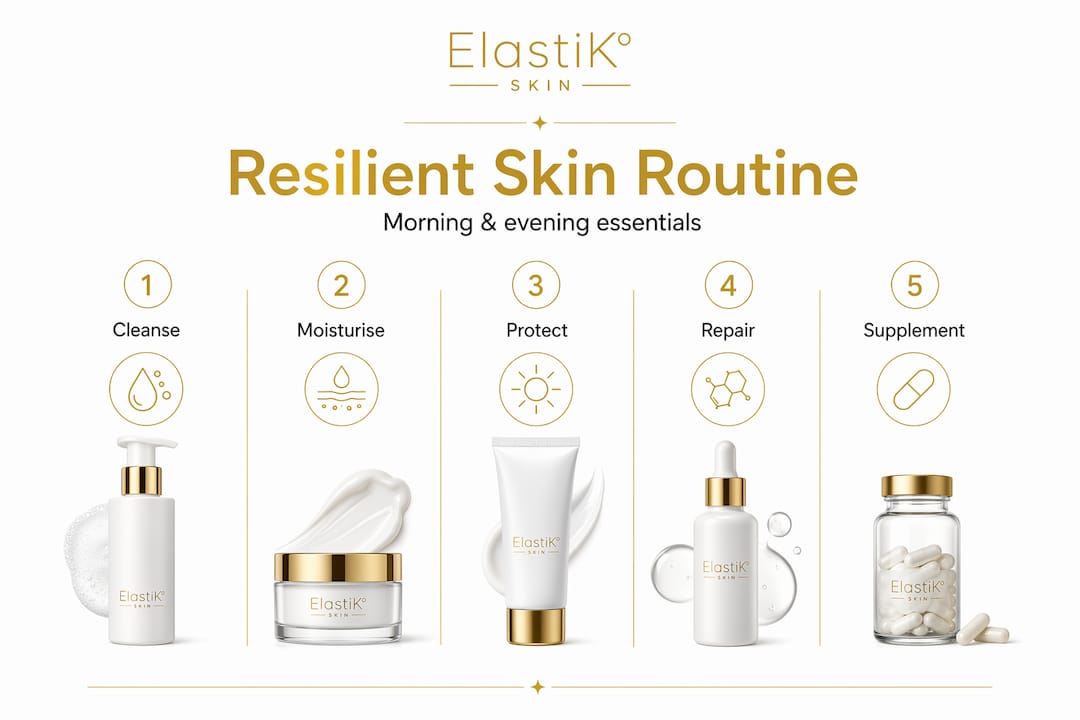
Here is a practical breakdown of the product categories you need and what each one does:
| Product type | Key ingredients | Primary function |
|---|---|---|
| Gentle cleanser | Glycerin, ceramides | Removes impurities without stripping moisture |
| Hydrating serum | Hyaluronic acid, Tripeptide-29, niacinamide | Boosts hydration and supports collagen signalling |
| Moisturiser | Ceramides, glycerin, peptides | Seals in moisture and reinforces the skin barrier |
| Broad-spectrum SPF 30+ | Zinc oxide or chemical filters | Prevents UV-induced collagen breakdown daily |
| Retinoid or retinol | Retinol, bakuchiol (gentler alternative) | Stimulates collagen production overnight |
One category many people overlook is supplements. Daily collagen peptides of 2.5 to 10 g can support skin firmness and hydration when taken consistently. They work from the inside in a way topical products cannot fully replicate. If you are unsure where to start, a conversation with your GP or a dermatologist will help you personalise your approach.
Pro Tip: When choosing a cleanser, look for the word “non-foaming” or “cream cleanser” on the label. Foaming cleansers often contain sulphates that strip the lipid layer your barrier depends on.
Your morning routine, step by step
The morning routine has one primary goal: protect. You are preparing your skin to face UV exposure, pollution, and environmental stress. Every step feeds into that objective.
-
Cleanse gently. Use lukewarm water and a cream or gel cleanser. Avoid anything that leaves your skin feeling tight afterwards. If your skin feels comfortable immediately after rinsing, the cleanser is doing its job without over-stripping.
-
Apply a targeted serum. This is where your actives go. Look for antioxidants like vitamin C, or peptide-rich formulas that support collagen architecture. A clinical study found that a twice-daily serum combining Tripeptide-29 with niacinamide produced a 72.5% increase in hydration and a 93.7% reduction in facial dryness over four weeks in women aged 36 to 65. That is not a trivial result.
-
Moisturise. Apply your ceramide-rich moisturiser while your skin is still slightly damp from the serum. This locks in the hydration rather than letting it evaporate.
-
Apply SPF last. Daily sunscreen is the single most effective anti-ageing product dermatologists recommend, largely because UV radiation is the primary driver of collagen degradation. The correct amount is roughly half a teaspoon for the face, or two full lines across your index and middle fingers. Cover your neck and the backs of your hands too. Both age visibly and are frequently forgotten.
-
Choose your SPF texture deliberately. For mature skin, a lightweight fluid or tinted SPF tends to encourage daily use more than a thick, white-cast formula. Adherence matters more than the specific SPF number once you are above SPF 30.
The core three steps of cleansing, moisturising, and applying sunscreen form the minimum effective daily skincare for elasticity. Everything else is an enhancement on top of that foundation.
Pro Tip: Apply your SPF to dry skin, not on top of a wet moisturiser. Diluting sunscreen reduces its protective coverage, which defeats the purpose entirely.
Evening routine for repair and renewal
The evening routine has a different goal: repair. Your skin enters a regenerative state overnight, and the right products can work with that biology rather than against it.
-
Double cleanse if you wore SPF or makeup. Use a cleansing balm or micellar water first, then follow with your regular cream cleanser. This prevents residue from sitting on the skin all night and blocking the actives you apply next.
-
Introduce a retinoid, carefully. Retinoids are the most evidence-backed ingredient for stimulating collagen and improving skin texture. Start at twice weekly. Ramping retinoid use by skin tolerance through frequency adjustments or buffering with moisturiser reduces irritation and supports long-term elasticity improvements. If your skin feels dry or flaky, try the “sandwich” method: apply moisturiser first, then retinoid, then moisturiser again.
-
On non-retinoid nights, focus on barrier repair. Apply a richer moisturiser or a ceramide-heavy night cream. These nights are not wasted. They are when your barrier consolidates the work done by the retinoid. Alternate moisturisation on non-retinoid nights is specifically recommended to protect the barrier and maintain routine tolerability.
-
Exfoliate sparingly. Once a week maximum for mature skin, using a gentle lactic acid or enzyme formula. Over-aggressive exfoliation weakens the barrier and worsens the appearance of fine lines, which is the opposite of what you are trying to achieve.
-
Finish with a barrier-supporting night cream. Even on retinoid nights, a light layer of moisturiser over the top helps seal everything in and prevents transepidermal water loss while you sleep.
Pro Tip: If you find retinoids consistently irritating even at twice weekly, consider a bakuchiol-based alternative. It works through a different mechanism but delivers comparable collagen-supporting results with far less sensitivity.
Adjusting your routine as your skin changes
A routine that works perfectly at 38 may need recalibrating at 48. Skin continues to change, and the ability to read those signals is what separates a good routine from a great one.
Watch for these signs that your routine needs adjusting:
- Persistent tightness or flaking after cleansing suggests your cleanser is too stripping or your moisturiser is not rich enough.
- Breakouts or congestion after adding a new product usually indicate the product is not suited to your skin type or you are layering too many actives at once.
- Redness or stinging from a product you have used before can signal that your barrier is compromised. Pull back to basics: cleanser, moisturiser, SPF only, for one to two weeks before reintroducing actives.
- No visible change after 12 weeks of consistent use is a signal to reassess your actives. Skin cell turnover slows with age, so results take longer, but 12 weeks of nothing suggests the formula is not working for you.
Elasticity and firmness improvements depend on repeated barrier and matrix support over time rather than any single application. Expect to see meaningful changes in hydration within four weeks, and improvements in texture and firmness closer to eight to twelve weeks. Photograph your skin in the same light every four weeks. Progress is often gradual enough that you will not notice it day to day, but the comparison photos tell a different story.
When to consult a professional: if you are dealing with significant sensitivity, rosacea, or hormonal skin changes, a dermatologist can prescribe prescription-strength retinoids or recommend in-clinic treatments that complement your home routine rather than replace it.

My honest take on building a routine that actually lasts
I lost over 126 pounds, and the skin changes that came with that were not something any generic skincare article prepared me for. What I learned from that experience, and from building Elastikskin around it, is that most people approach ageing skin backwards.
They reach for the most aggressive active they can find, get irritated and inflamed, then conclude that “nothing works for my skin.” What I have found actually works is starting with the barrier. Get your skin hydrated, comfortable, and stable first. Then introduce actives one at a time, slowly. The barrier-first approach is not the exciting answer, but it is the one that produces lasting results.
The other misconception I see constantly is that sunscreen is optional on cloudy days or when you are mostly indoors. It is not. UV radiation passes through glass and cloud cover. The people I have spoken to who have the most resilient skin in their 50s and 60s have one thing in common: they have worn SPF daily since their 30s without exception.
Listen to your skin. Some days it needs more moisture, some days it tolerates actives better. Adapting is not failure. It is how you maintain a routine for years rather than weeks. And years is what this requires.
— Marc
How Elastikskin supports your resilience routine
If you are ready to move from principles to products, Elastikskin has formulated specifically for skin that is going through change, whether from weight loss, hormonal shifts, or the natural progression of ageing.
The Collagen Architect Serum delivers Tripeptide-29 and niacinamide in a clinically-backed formula designed for daily morning use. The Resilience Matrix Night Cream combines ceramides and peptides to support overnight barrier repair on non-retinoid nights. For those looking to go further, the LED Face and Neck Mask uses red light therapy to support collagen production at a cellular level, complementing everything your topical routine is already doing. Visit the complete skincare system page to see how these products work together as a cohesive daily regimen.
FAQ
What is the best daily routine for aging skin resilience?
The most effective routine combines gentle cleansing, a peptide or antioxidant serum, a ceramide-rich moisturiser, and daily SPF in the morning, with retinoids twice weekly and barrier-focused moisturisation in the evening. Consistency over weeks and months produces the most meaningful improvements in elasticity and firmness.
How long before I see results from a new skincare routine?
Hydration improvements are typically visible within two to four weeks. Texture, firmness, and elasticity changes take closer to eight to twelve weeks of consistent daily use. Photographing your skin every four weeks in the same lighting helps track gradual progress that is easy to miss day to day.
Can I use retinol every night if I have mature skin?
Starting retinol every night is not recommended for mature skin. Begin at twice weekly and build frequency gradually based on how your skin responds. Using a moisturiser before and after retinol application reduces irritation and makes the routine sustainable long term.
Which ingredients are most important for skin elasticity?
Peptides, ceramides, niacinamide, and retinoids are the most evidence-backed ingredients for supporting elasticity in mature skin. Peptides signal collagen production, ceramides reinforce the barrier, niacinamide reduces inflammation, and retinoids directly stimulate collagen synthesis overnight.
Does sunscreen really make a difference for aging skin?
Yes, significantly. Daily broad-spectrum SPF is widely regarded by dermatologists as the most effective single step for preventing further collagen breakdown in mature skin. UV radiation is the primary external driver of visible ageing, and consistent daily use from your 30s onwards produces measurable long-term differences in skin resilience.
0 comments