ElastiK° Skin | Skin in Evolution™
BAKUCHIOL VS RETINOL: WHICH ONE ACTUALLY WORKS BETTER?
By Marc McKee, Founder of ElastiK° Skin
TL;DR: THE ESSENTIAL POINTS
- There is one head-to-head trial. A randomised, double-blind study in the British Journal of Dermatology compared them directly over 12 weeks in 44 people.1
- Similar results, less irritation. Both improved wrinkles and pigmentation, with no significant difference between them. Retinol caused significantly more stinging and scaling.1
- Retinoids have far more evidence overall. Prescription tretinoin has been studied for photoageing since the 1980s, including a landmark study showing it partially restored collagen formation in sun-damaged skin.2,3
- Bakuchiol is not "natural retinol". It is a different molecule. Lab studies suggest it switches on some of the same genes in skin cells, which may explain the similar results.4
- The one you keep using wins. An active you use for six months does more than a stronger one you give up on in week three.
This is one of the most asked questions in skincare, and most answers to it pick a side rather than look at the evidence.
Retinol fans think bakuchiol is marketing. Bakuchiol fans think retinol is unnecessary suffering. Neither view holds up against the actual data.
So here is the honest version, including the parts that do not favour the ingredient I put in my own product.
Where I am coming from.
I use bakuchiol in Evolve Serum. That is a reason to read this critically, so I have set out exactly what the evidence says and where retinoids are stronger.
01. WHAT EACH ONE ACTUALLY IS
RETINOIDS ARE A FAMILY, NOT ONE THING
"Retinol" gets used loosely. The vitamin A family runs from retinyl esters to retinol, retinaldehyde and prescription tretinoin (retinoic acid). The skin converts the weaker forms, step by step, into retinoic acid, which is the form that acts on skin cells.5 That is why over-the-counter retinol is gentler and weaker than a prescription retinoid.
BAKUCHIOL IS NOT A RETINOID
Bakuchiol comes from the seeds of the Psoralea corylifolia plant. Its structure is unrelated to vitamin A, so "natural retinol" is marketing shorthand, and it is wrong.
What makes it interesting is that, in laboratory skin models, it changed the activity of many of the same genes as retinol.4 That may explain why the results in the clinic look similar. One caveat: that lab research was carried out by people linked to a bakuchiol supplier.
Different molecule, similar destination. That is the whole story, and it is more interesting than either marketing version.
02. THE HEAD-TO-HEAD TRIAL
Most comparisons online cite nothing. There is one direct trial, and it is worth knowing properly.
WHAT THEY DID
Researchers randomly assigned 44 people to use either 0.5% bakuchiol cream twice a day or 0.5% retinol cream once a night for 12 weeks. Neither participants nor assessors knew who was using which. Wrinkles and pigmentation were measured by computer analysis of standardised facial photos, and a dermatologist who did not know the groups graded redness, pigmentation and scaling.1
WHAT THEY FOUND
| Measure | Result |
|---|---|
| Fine wrinkle area | Down 19% with bakuchiol and 23% with retinol. Both significant, no significant difference between them.1 |
| Pigmentation | Both improved, no significant difference between them.1 |
| Stinging and scaling | Significantly more common with retinol.1 |
| Sun sensitivity | None reported in either group.1 |
THE HONEST CAVEATS
- It is one small trial. 44 people over 12 weeks. One study is a signal, not a settled answer.
- It compared bakuchiol with over-the-counter retinol, not with prescription tretinoin. Nobody should read it as bakuchiol matching a prescription retinoid.
- The doses were different. Bakuchiol was used twice a day, retinol once a night.
- It did not test whether they are equivalent. "No significant difference" in a small trial is not proof they are the same.
Anyone citing this study as proof that bakuchiol beats retinol is overreading it.
03. WHERE RETINOIDS ARE GENUINELY STRONGER
This is the section a brand selling bakuchiol would normally leave out.
DECADES MORE EVIDENCE
Tretinoin has been studied for sun-damaged skin since the 1980s.3 In a landmark study in the New England Journal of Medicine, 10 to 12 months of daily tretinoin raised collagen formation in sun-damaged skin by 80%, compared with a 14% fall with a placebo cream.2 Bakuchiol has nothing like that depth of evidence.
PRESCRIPTION STRENGTH HAS NO EQUIVALENT
If you have significant sun damage and your skin can tolerate it, a prescription retinoid from your GP or dermatologist remains the strongest topical option. Nothing over the counter, bakuchiol included, matches it.
RETINOIDS ARE ESTABLISHED FOR ACNE
Topical retinoids are a standard part of acne treatment in UK guidance.6 Bakuchiol is not. If acne is your main concern, speak to your GP or pharmacist.
The straight answer.
If your skin tolerates a retinoid, you have no reason to avoid one, and you want the deepest evidence, use a retinoid. Prescription if a clinician agrees it is right for you.
04. WHERE BAKUCHIOL WINS
THE ACTIVE YOU KEEP USING BEATS THE ONE YOU ABANDON
Stinging, flaking and redness are common when you start a retinoid, and many people give up on topical treatments long before they have had time to work. An active you use a few nights a week for a year does more than a stronger one used for six weeks and left in a drawer. Visible changes in fine lines and firmness take months. If you do not last that long, strength was irrelevant.
SENSITIVE OR CHANGING SKIN
Many people say their skin feels drier and more reactive while it is changing quickly, whether through weight loss, perimenopause or after having a baby. How GLP-1 medicines affect the skin is still being worked out by researchers.7 If your skin already stings, flakes or feels tight, a retinoid is often hard to tolerate, and the real choice may be between bakuchiol and nothing.
PREGNANCY AND BREASTFEEDING
Prescription topical retinoids should not be used in pregnancy or if you are planning a pregnancy.8 Bakuchiol is not a retinoid, but there is very little safety data for it in pregnancy or breastfeeding, so check with your GP, midwife or pharmacist before using it.
The best active is the strongest one you will still be using in six months. For a lot of people that is not a retinoid, and pretending otherwise helps nobody.
05. HOW TO CHOOSE
| Your situation | What to consider |
|---|---|
| Robust skin, no history of irritation, want the most evidence | A retinoid. Prescription if a clinician agrees. |
| Tried retinol and stopped because of irritation | Bakuchiol. |
| Skin feels dry, tight or reactive right now | Bakuchiol, after a few weeks of focusing on hydration and moisture first. |
| Twenties, thinking about prevention | Either, at a low strength, two or three nights a week. Daily sunscreen matters more. |
| Acne is the main concern | See your GP or pharmacist. It is a medical question. |
| Pregnant, planning a pregnancy or breastfeeding | Avoid retinoids. Ask your GP, midwife or pharmacist before using bakuchiol. |
RULES THAT APPLY TO BOTH
- Use them in the evening. Introduce either one slowly, starting with two or three nights a week.
- Look after your barrier first. A couple of weeks of hydration and a good moisturiser makes any active easier to tolerate. Products with ceramides and similar lipids help skin hold on to water.9
- Wear sunscreen every day. UV light switches on the enzymes that break down collagen, so using an active without sun protection works against itself.10
- Judge it at three to four months, not four weeks. Comfort changes quickly. Fine lines do not.
I chose bakuchiol for Evolve Serum, alongside rosehip, evening primrose and jojoba oils, because the people I made it for often have skin that is already under strain. That is a decision about who it is for, not a claim that bakuchiol is better for everyone.
06. THE SKIN IN EVOLUTION™ SYSTEM
An active is one step in a routine, and not the one that changes how your skin feels fastest. Here is where it sits.
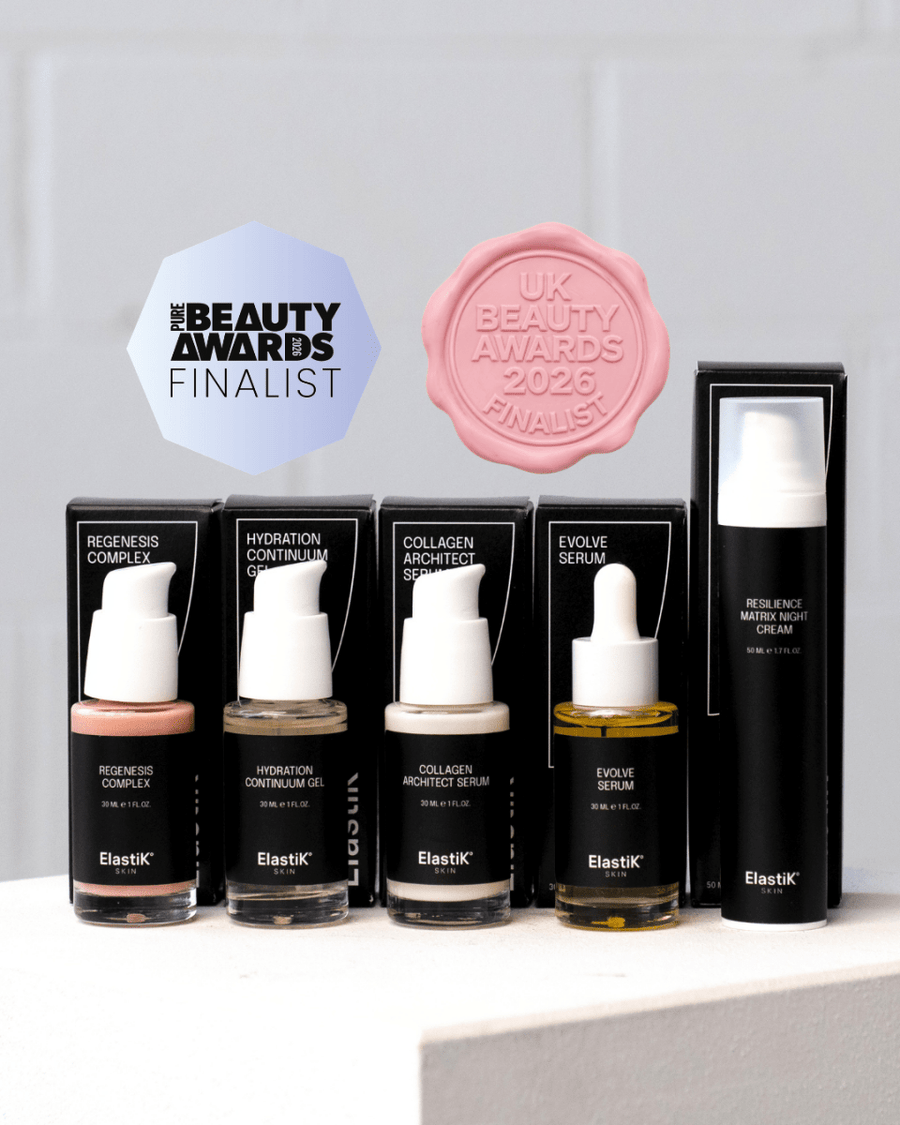
HYDRATION CONTINUUM GEL
Two forms of hyaluronic acid with sodium PCA and aloe, straight after your morning shower. An industry-funded review concluded that hyaluronic acid products improve hydration and signs of ageing, while calling for more well-controlled trials.11
COLLAGEN ARCHITECT SERUM
A silky serum with multi-weight hyaluronic acid that supports the look of firmer, more hydrated skin on the face, neck and chest. It goes on in the morning, which keeps the evening free for your active.
ELASTIK° SKIN LED FACE + NECK MASK
234 LEDs across the face and neck, used on clean, dry skin before your evening skincare. Start at 5 minutes and build to 10. Not suitable during pregnancy. In a controlled trial, red and near-infrared light from lamp-based units (not an LED mask) improved fine lines and roughness, with an increase in collagen density measured by ultrasound.12
REGENESIS COMPLEX
A peptide serum with hexapeptide-11 and dipalmitoyl hydroxyproline for the face and body. Body skin rarely gets any attention in a routine, and it changes too.
EVOLVE SERUM
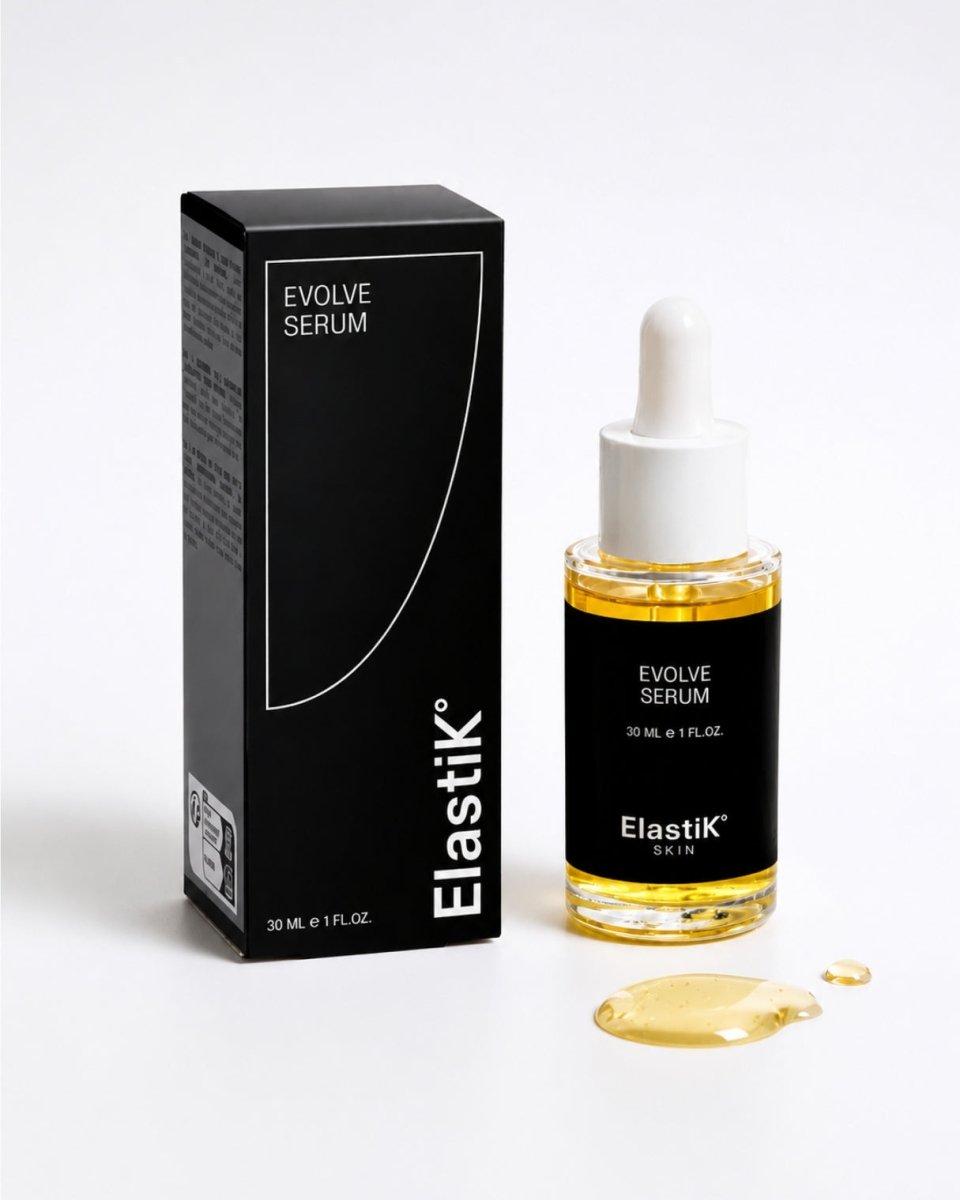
The bakuchiol step: bakuchiol with rosehip, evening primrose and jojoba oils, straight after Regenesis Complex. An oil serum, so it goes on after the water-based layers. Start on a few evenings a week and build up.
RESILIENCE MATRIX NIGHT CREAM
A rich overnight cream with shea and cocoa butter and plant barrier lipids, applied last. If an active has left your skin feeling irritated, this is the step that helps it feel comfortable again.
07. FAQ
IS BAKUCHIOL JUST NATURAL RETINOL?
No. It is a different molecule, unrelated to vitamin A. Lab studies suggest it affects some of the same genes, which may explain the similar results.4
CAN I USE BOTH?
Some people alternate them on different nights. No trial has tested the combination, so you would be experimenting. If your skin is sensitive, pick one.
DOES BAKUCHIOL MAKE YOU SENSITIVE TO THE SUN?
No sun sensitivity was reported with bakuchiol in the head-to-head trial.1 That is not a reason to skip sunscreen. UV breaks down the collagen you are trying to protect.10
HOW LONG BEFORE I SEE ANYTHING?
In the trial, both groups showed measurable changes at 12 weeks.1 Comfort and texture can change sooner. Most people give up in the gap between the two.
I AM ON A GLP-1 MEDICATION. WHICH SHOULD I USE?
There is no research on either ingredient in people taking GLP-1 medicines. If your skin feels drier or more reactive than usual, bakuchiol is the gentler starting point. Spend a couple of weeks on hydration first, then introduce it slowly.
IS PRESCRIPTION TRETINOIN WORTH ASKING ABOUT?
If your skin is robust and you want the strongest evidence, yes. It is a prescription medicine, so that decision is for your GP or dermatologist.
RELATED ARTICLES FROM THE SKIN JOURNAL
SOURCES
All sources checked in October 2026.
-
Dhaliwal S, Rybak I, Ellis SR, et al. Prospective, randomized, double-blind assessment of topical bakuchiol and retinol for facial photoageing. British Journal of Dermatology, 2019;180(2):289–296.
Read the source -
Griffiths CEM, Russman AN, Majmudar G, et al. Restoration of collagen formation in photodamaged human skin by tretinoin (retinoic acid). New England Journal of Medicine, 1993;329(8):530–535.
Read the source in the NEJM -
Kligman AM, Grove GL, Hirose R, Leyden JJ. Topical tretinoin for photoaged skin. Journal of the American Academy of Dermatology, 1986;15(4 Pt 2):836–859.
Read the source on PubMed -
Chaudhuri RK, Bojanowski K. Bakuchiol: a retinol-like functional compound revealed by gene expression profiling and clinically proven to have anti-aging effects. International Journal of Cosmetic Science, 2014;36(3):221–230.
Read the source -
Mukherjee S, Date A, Patravale V, et al. Retinoids in the treatment of skin aging: an overview of clinical efficacy and safety. Clinical Interventions in Aging, 2006;1(4):327–348.
Read the source on PubMed Central -
National Institute for Health and Care Excellence. Acne vulgaris: management (NG198). NICE guideline, 2021.
Read the guideline -
Paschou IA, Sali E, Paschou SA, et al. GLP-1RA and the possible skin aging. Endocrine, 2025;89(3):680–685.
Read the source on PubMed Central -
Medicines and Healthcare products Regulatory Agency. Retinoids: updated measures for pregnancy prevention (letter to healthcare professionals). MHRA, June 2019.
Read the letter -
Kono T, Miyachi Y, Kawashima M. Clinical significance of the water retention and barrier function-improving capabilities of ceramide-containing formulations: A qualitative review. The Journal of Dermatology, 2021;48(12):1807–1816.
Read the source on PubMed Central -
Feng C, Chen X, Yin X, Jiang Y, Zhao C. Matrix Metalloproteinases on Skin Photoaging. Journal of Cosmetic Dermatology, 2024;23(12):3847–3862.
Read the source on PubMed Central -
Bravo B, Correia P, Gonçalves Junior JE, et al. Benefits of topical hyaluronic acid for skin quality and signs of skin aging: From literature review to clinical evidence. Dermatologic Therapy, 2022;35(12):e15903.
Read the source on PubMed Central -
Wunsch A, Matuschka K. A Controlled Trial to Determine the Efficacy of Red and Near-Infrared Light Treatment in Patient Satisfaction, Reduction of Fine Lines, Wrinkles, Skin Roughness, and Intradermal Collagen Density Increase. Photomedicine and Laser Surgery, 2014;32(2):93–100.
Read the source on PubMed Central
This article is general information, not medical advice. ElastiK° products are cosmetics and support the appearance of skin; they do not treat medical conditions.