ElastiK° Skin | Skin in Evolution™
MENOPAUSE SKIN CHANGES: WHAT HAPPENS TO COLLAGEN, AND WHAT HELPS
By Marc McKee, Founder of ElastiK° Skin
TL;DR: THE ESSENTIAL POINTS
- Skin changes are a recognised part of menopause. The NHS lists dry and itchy skin among the symptoms of perimenopause and menopause.1
- Collagen falls fastest in the first few years. Dermatology reviews estimate that around 30% of skin collagen is lost in the first five years after menopause, followed by a slower decline of about 2% a year.2,3
- It is about oestrogen, not just age. The loss is more closely linked to how long oestrogen has been low than to how old you are.2
- HRT is a conversation for your GP, not a skincare decision. NHS and NICE guidance is that HRT is chosen with a doctor, based on your symptoms and your own risks.4,5
- Sunscreen, moisturiser and consistency matter more than any single product. Skincare supports how skin looks and feels. It does not put back lost collagen.
Today is World Menopause Day, and the question we are asked most in our community is a simple one: why has my skin changed so quickly?
Women tell us their skin feels drier than it ever has. That it looks thinner, especially on the neck and chest. That make-up sits differently. That the crepey texture they expected in their sixties has turned up in their late forties.
I am not going to pretend I know what menopause feels like. I don't. What I can do is set out what the evidence says, as plainly as I can, and be clear about where skincare helps and where it does not.
This is not only a GLP-1 article.
Many women in our community are going through menopause and taking a weight-loss medicine at the same time. Many are not. The skin biology below applies either way, and so does the routine.
This article covers what happens to collagen and the skin barrier during menopause, why the timing matters, where HRT fits, and what a sensible routine looks like.
01. WHAT OESTROGEN DOES FOR YOUR SKIN
Oestrogen is not only a reproductive hormone. Skin responds to it, and when levels fall, the skin notices.
IT SUPPORTS COLLAGEN
Collagen is the protein that gives the dermis, the deeper layer of skin, its strength and thickness. A 2025 clinician's review by a UK consultant dermatologist describes how oestrogen supports this structure, and how women lose an estimated 30% of their skin collagen in the first five years after menopause.2
IT HELPS SKIN HOLD WATER
The same review explains that oestrogen increases the water-holding capacity of the outer layer of skin, which supports the barrier, and raises levels of hyaluronic acid and related molecules in the dermis.2 When oestrogen falls, skin tends to feel drier and less plump.
IT AFFECTS ELASTICITY
A review in Clinical and Experimental Dermatology notes that changes to elastin, the protein that lets skin spring back, increase with menopause and show up as slacker skin and more wrinkling.3
Menopause skin is not simply older skin. It is skin that has lost one of the signals it relied on to stay thick, hydrated and resilient.
02. WHAT HAPPENS TO COLLAGEN, AND WHEN
THE FIRST FIVE YEARS
The figure you will see quoted most often is that roughly a third of skin collagen is lost in the first five years after menopause. Two separate dermatology reviews give the same picture: around a third in the first five years.2,3 One adds that the decline then slows to about 2.1% a year.3
Much of this comes from older biopsy studies. One from 1987 found that skin collagen, skin thickness and bone density all fell at a similar rate of 1 to 2% a year after menopause, and that the three were linked.6 These were small, early studies, and the exact numbers will vary from person to person. The direction is consistent across the research.
IT TRACKS OESTROGEN, NOT BIRTHDAYS
The collagen loss is more closely linked to how long oestrogen has been low than to chronological age.2 That is why two women of the same age can have very different skin, and why someone with an early menopause can notice these changes sooner.
WHAT YOU MIGHT NOTICE
A review in the Journal of the American Academy of Dermatology lists the changes linked to low oestrogen after menopause: thinner skin, less collagen, less moisture, looser skin, fine wrinkling and slower healing.7
| What changes | What you may notice | What skincare can realistically do |
|---|---|---|
| Collagen in the dermis | Thinner, less firm-looking skin, especially face, neck and chest2,7 | Support the look of firmer skin. It cannot replace lost collagen |
| Water-holding and barrier | Tightness, dryness, flaking, make-up sitting differently2 | A lot. Hydration and barrier care make a visible difference to comfort and texture |
| Elastin | Skin that is slower to spring back, crepey texture3 | Improve how the surface looks and feels. It does not tighten loose skin |
| Itch | Itchy skin, often alongside dryness3,8 | A gentle, regular moisturiser often helps. Persistent or severe itch needs a GP |
03. DRYNESS AND ITCH: MORE COMMON THAN PEOPLE THINK
Dry skin is one of the changes women mention to us first, and it is well recognised. The Menopause Charity lists dry or itchy skin, changes in texture and sensitivity among more than 34 symptoms, and stresses that everyone's experience is different.9
A 2026 systematic review of menopause and skin conditions highlights one study where dry skin was found in 78% and itch in 46% of 150 postmenopausal women.8 That is one study in one population, so the exact numbers will not apply everywhere. It does show how common this is.
Itch tends to come with dryness. The Clinical and Experimental Dermatology review describes itching as frequent after menopause, commonly alongside dry skin, and lists a low-pH moisturiser at least once a day among the general measures.3
When to see a GP.
If itching is severe, all over your body, keeps you awake, or comes with a rash, broken skin or anything that looks different from simple dryness, see your GP. Other conditions can cause itch, and they need checking.
04. WHERE HRT FITS
This is the part where I am careful, because it is a medical decision and not mine to make for anyone.
There is research showing that oestrogen therapy is linked to higher skin collagen and thicker skin.3 But HRT is used to relieve menopause symptoms and to help prevent osteoporosis.4 It is not prescribed as a skin treatment.
The NHS says the benefits of HRT usually outweigh the risks, particularly for women under 60 who have symptoms and are not at high risk of breast cancer or blood clots, and that a GP will help you decide.4 The NICE guideline on menopause asks doctors to take an individualised approach at every stage.5
IF YOU ARE ALSO TAKING A GLP-1
The British Menopause Society has published guidance for clinicians on using semaglutide or tirzepatide alongside HRT. Because these medicines slow stomach emptying, there is a concern that oral progestogen may be absorbed less well, which matters for protecting the womb lining. The guidance discusses options such as non-oral progestogens.10 If you take both, tell your prescriber. Do not change anything yourself.
We cover this in more detail in HRT and GLP-1 Together: What It Means for Your Skin.
HRT is a conversation with your GP about your whole health. Better skin may be a side benefit for some women. It should never be the reason on its own.
05. WHAT ACTUALLY HELPS
I am going to be blunt, because this category is full of overpromising. No cream rebuilds the collagen menopause takes away. What good skincare does is keep the barrier healthy, keep skin hydrated and comfortable, protect it from further damage and support how it looks.
DAILY SUNSCREEN COMES FIRST
Sun exposure is one of the main drivers of visible skin ageing,11 and menopausal skin has less collagen to spare. The NHS recommends at least SPF 30 with at least 4-star UVA protection, on all exposed skin including the face, neck and ears, and points out that you can burn in the UK even when it is cloudy.12
The evidence for daily use is good. In a randomised trial of 903 adults under 55, those who used sunscreen every day showed no detectable increase in skin ageing over four and a half years, and 24% less skin ageing than those who used it when they chose to.11
MOISTURISE, AND DO IT AT THE RIGHT TIME
Dry, itchy menopausal skin responds to regular moisturising.3 The habit that makes the biggest difference is applying body products straight after a shower, while the skin is still slightly damp.
RETINOIDS, AND GENTLER ALTERNATIVES
The clinician's review describes how topical retinoids stimulate collagen production and improve skin elasticity.2 They can be irritating, and stronger versions are prescription only, so talk to a pharmacist or GP. Bakuchiol is a plant ingredient often chosen as a gentler alternative. Its research base is much smaller, and we have not found studies of it in menopausal skin specifically. You can read more in Bakuchiol vs Retinol.
BE CAREFUL WITH GADGETS AND BIG CLAIMS
The same review lists LED devices among the products for menopausal skin that lack high-quality evidence.2 We sell an LED mask, and I would still rather you heard that from us. Think of LED as an optional extra to a good routine, not a replacement for one.
The System: Topical Skincare · ElastiK° Skin
06. A ROUTINE FOR MENOPAUSE SKIN
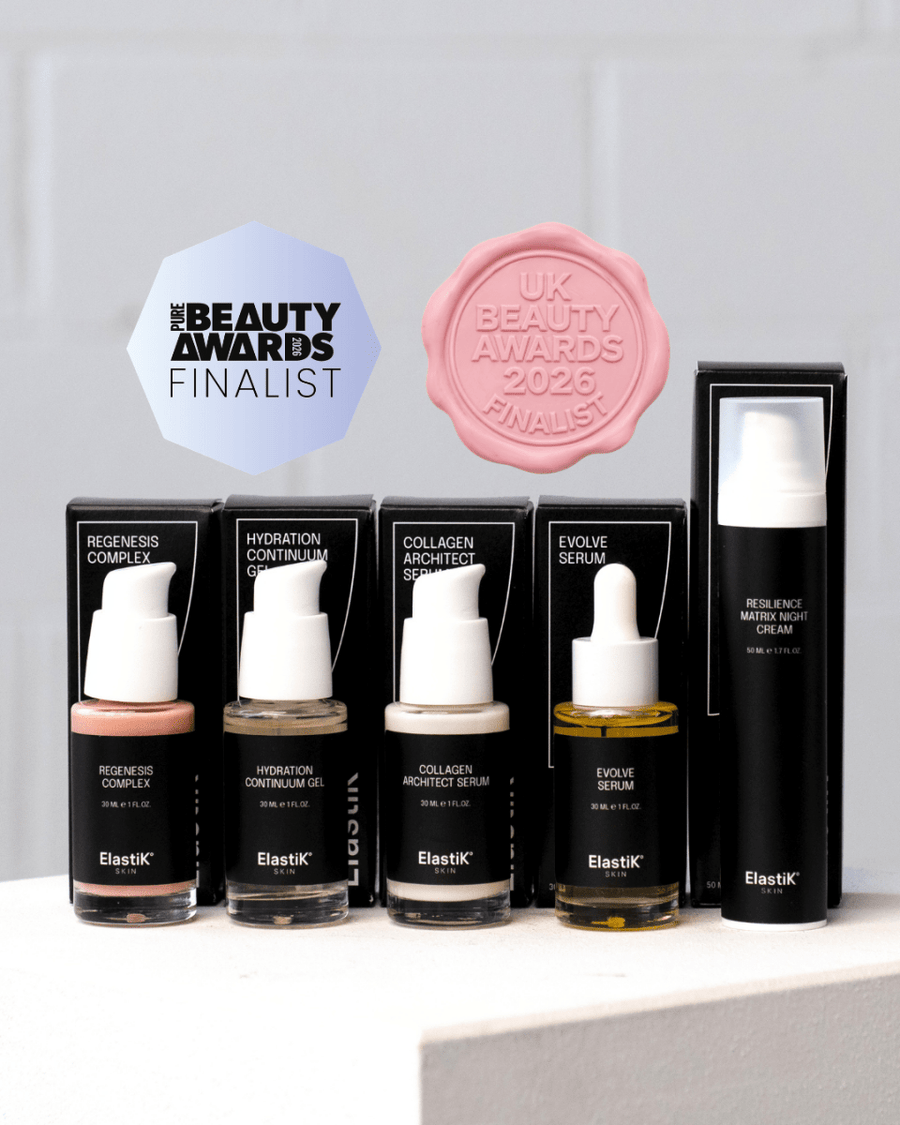
The Skin in Evolution™ System was made for skin going through rapid change: GLP-1 and other weight loss, perimenopause and menopause, and after pregnancy. These are the stages that matter most for menopausal skin.

HYDRATION CONTINUUM GEL
Two forms of hyaluronic acid with sodium PCA and aloe. Straight after your morning shower on the face, neck, décolletage and arms.
Oestrogen helps skin hold on to water, so as it falls, skin often feels tight and dry by midday.2 A light hyaluronic acid gel on slightly damp skin is a simple first layer of hydration before anything else goes on.

COLLAGEN ARCHITECT SERUM
A silky serum with hyaluronic acid and sodium PCA that supports the look of firmer, more hydrated skin. Face, neck and décolletage, then your SPF.
Thinner, less firm-looking skin tends to show first on the face, neck and chest.2,7 This is a lightweight morning layer for exactly those areas that sits comfortably under sunscreen and make-up.

ELASTIK° SKIN LED FACE + NECK MASK
234 LEDs across the face and neck, on clean, dry skin in the evening before your skincare. Start at 5 minutes and build to 10. UK delivery only.
It adds a step without adding another product to skin that may already be more reactive. The evidence for LED in menopausal skin specifically is limited, so treat it as an optional extra to a good routine.2

REGENESIS COMPLEX
A peptide serum with hexapeptide-11 and dipalmitoyl hydroxyproline, for the face, neck, décolletage, arms or anywhere skin feels less firm. A small amount is enough.
Menopause changes are not only on the face. Regenesis Complex is made for face and body, so the neck, chest and arms, where women often notice crepey texture, get the same attention.

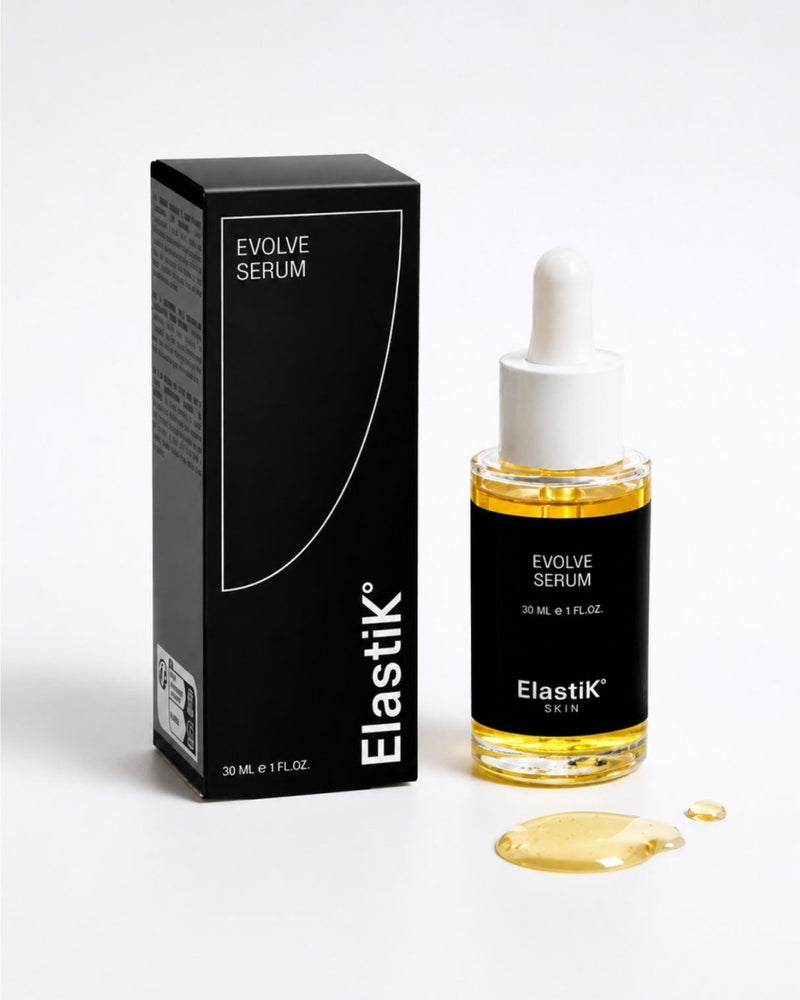
EVOLVE SERUM
Bakuchiol with rosehip, evening primrose and jojoba oils, straight after Regenesis Complex.
Retinoids are well studied but can be irritating, and drier, more sensitive skin can find them harder going.2 Bakuchiol is the gentler option, in a nourishing oil base. Start on a few evenings a week and build up.

RESILIENCE MATRIX NIGHT CREAM
A rich cream with shea and cocoa butter and plant glycosphingolipids, applied as you get into bed. For the face, neck and décolletage.
Dryness and itch are among the most common menopause skin complaints.3,8 A rich overnight cream supports the skin barrier and keeps skin comfortable while you sleep.
Before launch, we ran a small six-week trial of the routine with 11 people. All 11 said their skin felt more hydrated, and 9 of 11 said it felt more comfortable. It is a small, self-reported trial, and you can read exactly what we did on our evidence page.
07. FAQ
WHAT HAPPENS TO YOUR SKIN DURING MENOPAUSE?
Falling oestrogen means less collagen, thinner skin and less water held in the skin. Many women notice dryness, itch, crepey texture and looser skin on the face, neck and chest.1,2,7
HOW MUCH COLLAGEN DO YOU LOSE AFTER MENOPAUSE?
Dermatology reviews estimate around 30% in the first five years, then about 2% a year after that.2,3 These are averages from older studies. Your own skin will not follow the numbers exactly.
CAN SKINCARE REVERSE MENOPAUSE SKIN CHANGES?
No. Skincare cannot replace lost collagen or remove loose skin. It can keep the barrier healthy, improve hydration and comfort, protect against sun damage and support how your skin looks.
DOES HRT HELP MENOPAUSE SKIN?
Studies link oestrogen therapy with higher skin collagen and thicker skin.3 HRT is prescribed for menopause symptoms and bone health, not for skin, and the decision should be made with your GP.4,5
WHY IS MY SKIN SO ITCHY DURING MENOPAUSE?
Itch is common after menopause and usually comes with dry skin.3 A regular moisturiser often helps. See your GP if it is severe, widespread or not improving.
IS THIS ROUTINE ONLY FOR PEOPLE ON MOUNJARO OR WEGOVY?
No. It was made for any skin going through rapid change, including perimenopause and menopause, whether or not you are taking a weight-loss medicine.
RELATED ARTICLES FROM THE SKIN JOURNAL
SOURCES
All sources checked in October 2026.
-
NHS. Symptoms of menopause and perimenopause. nhs.uk, page last reviewed 19 May 2026.
Read the source on the NHS website -
DeGiovanni C. Managing Menopausal Skin: A Clinician's Review. EMJ Dermatology, 2025;13(1):90–94.
Read the source on EMJ -
Kamp E, Ashraf M, Musbahi E, DeGiovanni C. Menopause, skin and common dermatoses. Part 2: skin disorders. Clinical and Experimental Dermatology, 2022;47(12):2117–2122.
Read the source on PubMed Central -
NHS. Benefits and risks of hormone replacement therapy (HRT). nhs.uk, page last reviewed 8 February 2023.
Read the source on the NHS website -
National Institute for Health and Care Excellence (NICE). Menopause: identification and management (NG23). Published 12 November 2015, last updated 7 November 2024.
Read the source on the NICE website -
Brincat M, Kabalan S, Studd JWW, et al. A study of the decrease of skin collagen content, skin thickness, and bone mass in the postmenopausal woman. Obstetrics & Gynecology, 1987;70(6):840–845.
Read the source on PubMed -
Hall G, Phillips TJ. Estrogen and skin: the effects of estrogen, menopause, and hormone replacement therapy on the skin. Journal of the American Academy of Dermatology, 2005;53(4):555–568.
Read the source on PubMed -
Roster K, Fleshner L, Karatas TB, et al. Menopause and Common Dermatoses: A Systematic Review. American Journal of Clinical Dermatology, 2026;27:67–84.
Read the source -
The Menopause Charity. Join the dots: A-Z symptoms list. themenopausecharity.org.
Read the source on The Menopause Charity website -
Mukherjee A, Ghaem-Maghami S, Syed AA; British Menopause Society. Use of incretin-based therapies in women using hormone replacement therapy (HRT). BMS Tool for Clinicians, April 2025.
Read the source on the British Menopause Society website -
Hughes MCB, Williams GM, Baker P, Green AC. Sunscreen and prevention of skin aging: a randomized trial. Annals of Internal Medicine, 2013;158(11):781–790.
Read the abstract -
NHS. Sunscreen and sun safety. nhs.uk, page last reviewed 24 March 2026.
Read the source on the NHS website
This article is general information, not medical advice. ElastiK° products are cosmetics and support the appearance of skin; they do not treat medical conditions.