
ElastiK° Skin | Skin in Evolution™
POSTPARTUM AND GLP-1: WHAT'S HAPPENING TO YOUR SKIN
By Marc McKee, Founder of ElastiK° Skin
TL;DR: THE ESSENTIAL POINTS
- Two collagen events are landing on top of each other. The oestrogen drop after delivery and rapid GLP-1 weight loss both reduce collagen support, through different routes.1,2,3
- Your skin has already been through a full remodelling cycle. Pregnancy stretched the dermis and changed its structure. Starting rapid weight loss on top of that is a second demand on tissue that has not finished recovering.
- Stretch marks may still be in their active phase. Red or purple striae respond far better than mature white ones, so if yours are recent, that window matters.4
- Breastfeeding changes what is appropriate to use. Some actives are best avoided or discussed with your midwife, health visitor or GP first. That is a clinical question, not a skincare one.
- Timing is a medical decision, not a cosmetic one. When to start a GLP-1 medication after birth belongs with your prescriber. Nothing in this article should influence that.
This is the message I find hardest to answer well, because there are usually three things happening at once and only one of them is skin.
You have had a baby. Your hormones have dropped off a cliff. You are exhausted in a way that is difficult to describe to anyone who has not done it. And somewhere in there you have started a GLP-1 medication, and your skin has responded in a way nobody prepared you for.
I have not been through it. I am a 37-year-old man who lost nine stone on tirzepatide, so I know one half of this properly and the other half only from the hundreds of women who have written to me about it.
What I can and cannot help with.
I can explain the skin biology, because that part is documented. I cannot advise on when to start or stop a medication while postpartum or breastfeeding — that belongs entirely with your GP, midwife or prescriber, and it is genuinely important that it does.
So this covers what is actually happening in the tissue, why the two processes compound, and what is reasonable to do about the parts that are within your control.
01. WHAT PREGNANCY ALREADY DID TO YOUR SKIN
Before the weight loss enters the picture, your skin has completed a substantial structural project.
THE DERMIS WAS REMODELLED, NOT JUST STRETCHED
Skin does not simply expand like a balloon. The collagen and elastin network in the dermis physically reorganises to accommodate change. Where that reorganisation cannot keep pace with the mechanical demand, the network tears — which is what produces striae distensae, or stretch marks. A treatment review in the Indian Dermatology Online Journal describes these as dermal scarring with altered collagen and elastin architecture.4
That reorganisation does not reverse the moment you give birth. It continues for months.
OESTROGEN FELL OFF A CLIFF
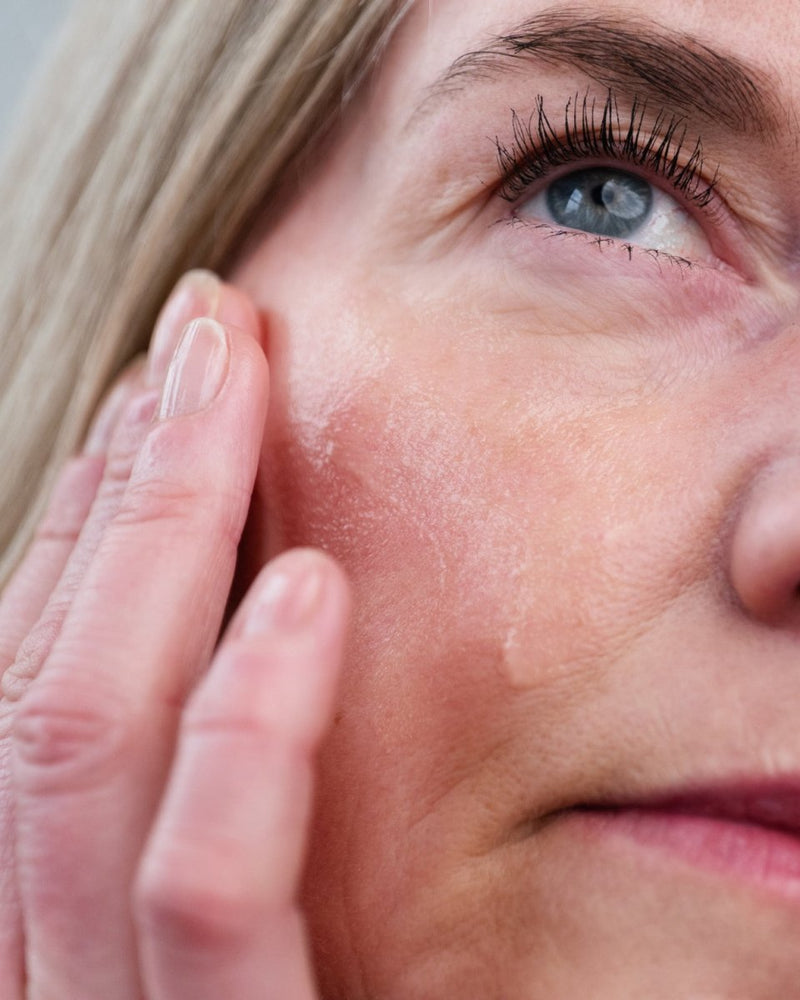
Oestrogen has a direct, well-documented role in skin biology. A review in Dermatology and Therapy examining oestrogen-deficient skin notes that skin collagen and elastin peak alongside peak oestrogen production, and that oestrogen decline brings loss of collagen, elastin and fibroblast function, together with reduced hydration driven by decreased water-binding molecules in the dermis.1
In menopause that decline happens over years. Postpartum it happens over days. The same mechanism, compressed into an extremely short window.
AND EVERYTHING ELSE
Sleep deprivation, altered nutrition, breastfeeding demands and the sheer physical load of caring for a newborn all affect skin recovery. None of that is a skincare failing on your part. It is context, and it is worth naming rather than ignoring.
It also explains why so much postpartum skincare advice lands badly. A ten-step evening routine assumes an evening. Most of the women who write to me are applying something one-handed at eleven at night, or not at all. Any recommendation that ignores that is not a recommendation, it is a wish.
Your skin has just finished a nine-month construction project and is midway through the demolition phase. Then a second project starts.
02. WHAT GLP-1 WEIGHT LOSS ADDS
Three mechanisms, and two of them hit targets that postpartum hormonal change has already weakened.
STRUCTURAL VOLUME LOSS
Subcutaneous fat is removed faster than the skin envelope can retract. A 2025 paper on facial ageing after GLP-1 induced weight loss describes the hollowing and loss of smooth facial transitions that follow when fat compartments deflate.2 This is genuinely additive — postpartum hormonal change does not do this.
REDUCED COLLAGEN SIGNALLING FROM WITHIN THE SKIN
This is the overlap that matters most. There is a layer of fat inside the skin itself, and it is metabolically active. Research in the Aesthetic Surgery Journal Open Forum describes how healthy fat cells there release adiponectin, which has been reported to increase hyaluronic acid and collagen production in fibroblasts and reduces MMP-1, the enzyme that degrades collagen.5
So oestrogen withdrawal has reduced fibroblast function, and rapid fat loss is now reducing the signal reaching those same fibroblasts. Two routes to the same result.
BARRIER COMPROMISE
A 2025 review in Endocrine discusses possible ways GLP-1 medicines might affect skin ageing, though it notes the mechanisms are not yet fully understood.3 Oestrogen decline has already reduced the dermis's water-binding capacity.1 Together, that can mean skin that feels drier and more reactive.
| What Changes | Postpartum Hormonal Drop | GLP-1 Weight Loss |
|---|---|---|
| Collagen production | Reduced fibroblast function1 | Reduced signalling from dermal fat5 |
| Hydration | Fewer water-binding molecules in the dermis1 | Reduced sebum, increased surface water loss3 |
| Dermal structure | Already remodelled by pregnancy, striae may be active4 | Further remodelling under a shrinking frame |
| Facial volume | Some redistribution, usually modest | Rapid loss of fat compartments2 |
Three of four rows filled in both columns. That is why this feels heavier than either alone, and it is not something you are imagining or handling badly.
03. THE BREASTFEEDING QUESTION
This section is short and deliberately cautious, because it should be.
If you are breastfeeding, the question of which topical ingredients are appropriate is a clinical one. Retinoids in particular are routinely discussed with prescribers during pregnancy and breastfeeding, and the sensible course is to ask rather than assume — your GP, midwife, health visitor or pharmacist can answer specifically for your situation.
What to ask, so you get a useful answer.
Take the actual product and its ingredient list to the appointment rather than describing it. “Is this appropriate while I am breastfeeding?” is a question a pharmacist can answer in two minutes if they can read the label.
WHAT IS GENERALLY UNCONTROVERSIAL
Hydration and barrier support — humectants like hyaluronic acid and barrier lipids like ceramides — are the least contentious part of any routine, because they work at the surface and upper layers. Ceramide-containing formulations have been shown to improve water retention and barrier function.6 If you want to do one thing while you wait for a proper conversation about the rest, this is the safe place to start.
ON THE MEDICATION ITSELF
Whether and when to use a GLP-1 medication postpartum or while breastfeeding is entirely a matter for your prescriber. I am not going to comment on it in either direction, and you should be sceptical of any skincare brand that does.
04. WHAT ACTUALLY HELPS
The good news is that the topical levers do not care which of the two processes caused the problem. They act on shared endpoints.
HYDRATION THAT WORKS AT DEPTH
A review of clinical evidence for topical hyaluronic acid in Dermatologic Therapy found consistent improvement in skin hydration and in the appearance of fine lines and skin quality with regular use.7 Molecular weight determines depth, so multi-weight formulations do more than single-weight ones. That is the reasoning behind Hydration Continuum Gel, applied to damp skin.
BARRIER SUPPORT
Both changes can leave skin feeling drier. Ceramide-containing formulations improve water retention and barrier function.6 That is the thinking behind Stage 1 hydration and Resilience Matrix Night Cream at Stage 5.
COLLAGEN SIGNALLING
Peptides are small chains of amino acids used in skincare to support the look of firmer skin. In our range they are in Regenesis Complex, for the face, neck, décolletage and body: stomach, inner arms and chest, which is where postpartum and weight-loss change actually shows.
IF YOUR STRETCH MARKS ARE STILL RED
Early striae are biologically active tissue and respond considerably better than mature white ones.4 If yours are recent, that is a genuine window rather than marketing urgency. Retinoids appear in the striae literature as a supported option for early marks4, and bakuchiol matched retinol for photoageing improvement with significantly less stinging and scaling in a randomised double-blind trial9 — but if you are breastfeeding, clear the active with your prescriber before starting it.
The realistic version of what to expect.
Barrier and hydration change is often visible in two to four weeks. Collagen-related change runs on a three to six month clock. Nothing here restores lost facial volume or removes a mature stretch mark, and anyone telling you otherwise is selling you something.
AND THE PART THAT IS NOT SKINCARE
You are unlikely to sustain an eight-step routine on four hours of broken sleep. Two products, applied on damp skin, twice a day, is a routine that survives contact with a newborn. That is worth more than an ideal routine you abandon in week two.
05. THE SKIN IN EVOLUTION™ SYSTEM
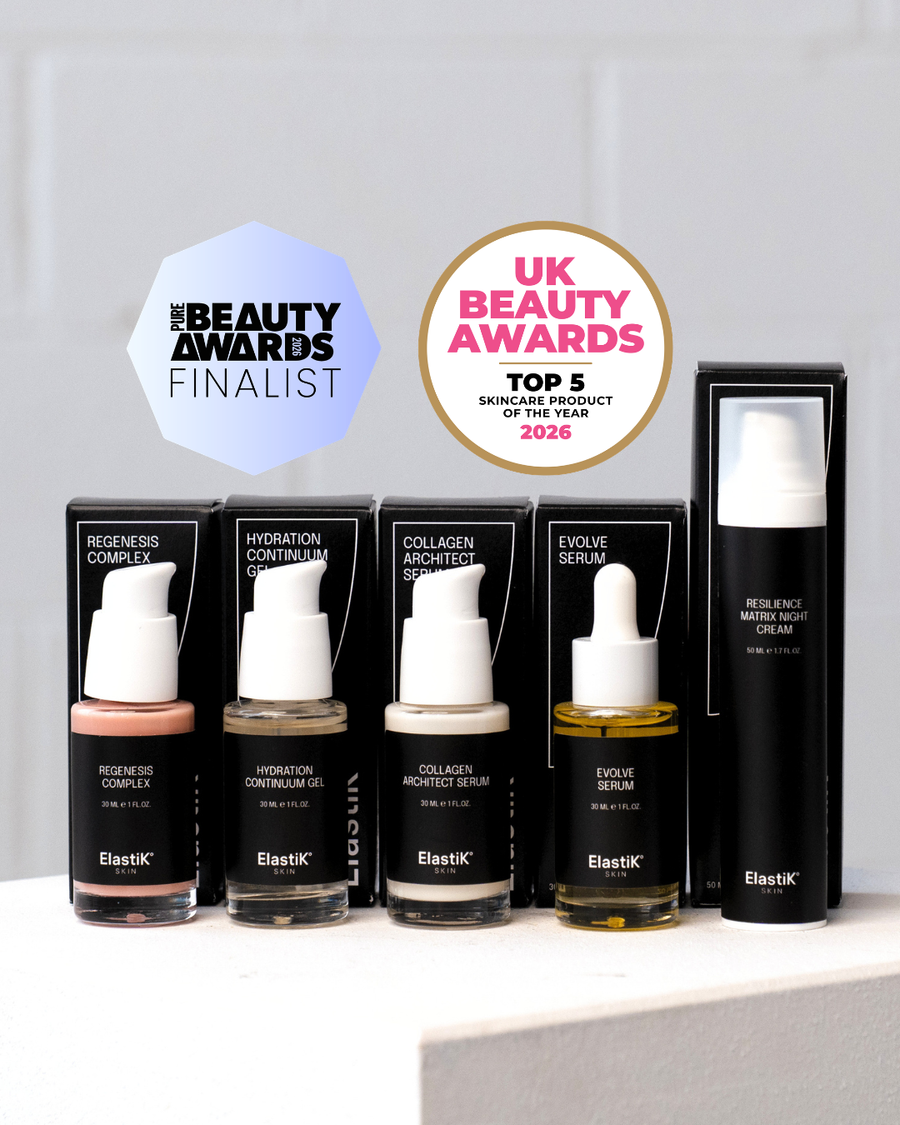
Every stage below acts on a mechanism that both postpartum hormonal change and rapid weight loss affect. If you only manage two, make them Stage 1 and Stage 5 — they cover the barrier and hydration side, which is where most of the daily discomfort sits.
HYDRATION CONTINUUM GEL
Two forms of hyaluronic acid with sodium PCA and aloe. Oestrogen withdrawal reduces the dermis's water-binding molecules,1 and this step helps the surface of the skin hold on to water. Applied to damp skin, twenty seconds. This is the one to start with.
COLLAGEN ARCHITECT SERUM
Multi-weight hyaluronic acid and sodium PCA in a silky serum for the face, neck and décolletage, supporting the look of firmer, more hydrated skin. Morning use, taken down the neck and chest.
ELASTIK° LED FACIAL MASK
234 LEDs delivering red and near-infrared wavelengths across the full face and neck. A controlled trial of lamp-based red and near-infrared light (not an LED mask) found improvement in fine lines, wrinkles and skin roughness with increased intradermal collagen density on ultrasound.10 Hands-free, which is the only reason it is realistic at this stage of life. Three to five times weekly.
REGENESIS COMPLEX
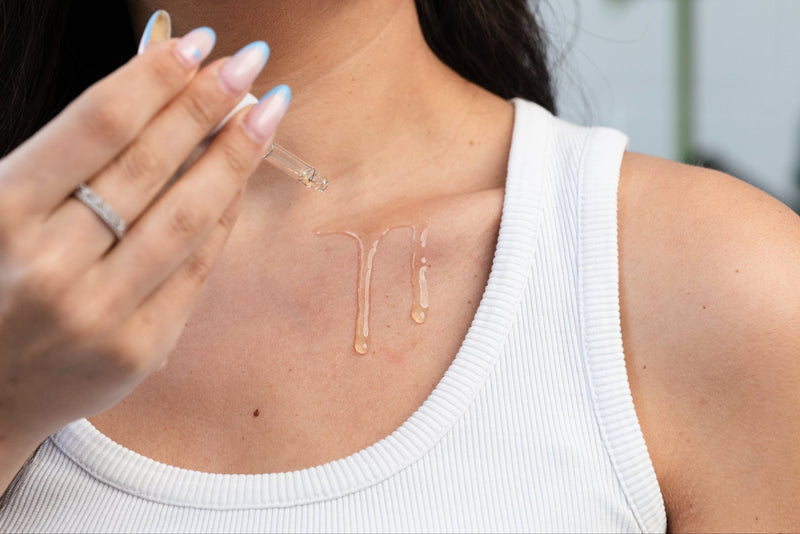
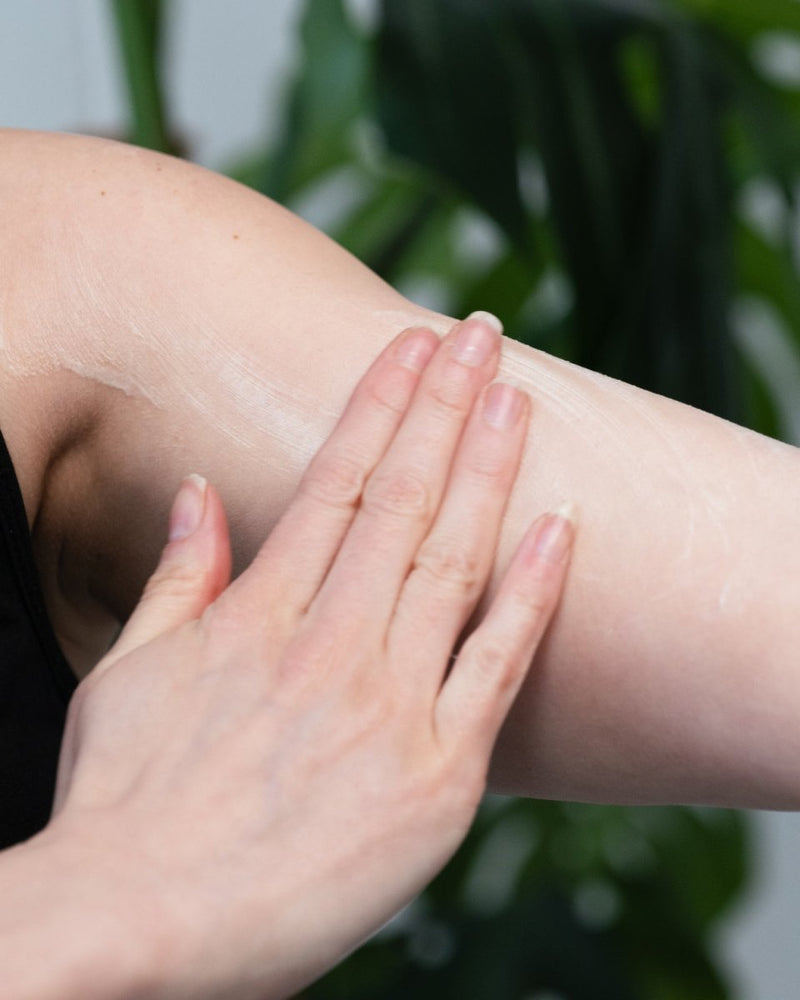
Peptide-rich body treatment for stomach, inner arms, décolletage and neck — the exact areas affected by both pregnancy and rapid weight loss, and the areas no facial product is formulated or sized for. Applied to damp skin straight after showering, which is the best absorption window body skin gets.
EVOLVE SERUM
Bakuchiol, rosehip and evening primrose oil for the evening. Bakuchiol matched retinol for improvement in photoageing with significantly less stinging and scaling in a randomised double-blind trial.9 If you are breastfeeding, check any evening active with your GP, midwife or pharmacist before starting. Three to five evenings weekly.
RESILIENCE MATRIX NIGHT CREAM
Ceramide-rich night cream, applied generously as the final evening step. Ceramide-containing formulations improve water retention and barrier function6, and the barrier is the shared casualty of both processes. Overnight is when most barrier repair happens — on interrupted sleep, this step earns its place more than usual.
06. FAQ
IS THIS THE BABY OR THE MEDICATION?
Almost always both. Facial volume loss that happened quickly points more to the weight loss. Dryness, reduced elasticity and changes that began before you started the medication point more to the hormonal drop. Most women in this position have a mixture, and the two are difficult to separate by looking.
CAN I USE THIS ROUTINE WHILE BREASTFEEDING?
Hydration and barrier products are the least contentious part and are generally uncontroversial. For any evening active, take the ingredient list to your GP, midwife or pharmacist and ask directly. That is a two-minute conversation and it is worth having rather than guessing.
WILL MY SKIN GO BACK TO HOW IT WAS BEFORE PREGNANCY?
Partly. Hydration and barrier function usually recover well with support. Structural change from pregnancy plus rapid weight loss recovers more slowly and often incompletely. I would rather tell you that plainly than have you measure yourself against a standard nobody meets.
WHEN CAN I START DOING SOMETHING ABOUT IT?
Hydration and barrier support can start whenever you have the capacity, including immediately. For actives, and for anything you are unsure about while breastfeeding, ask first. There is no benefit to rushing the active side by a few weeks.
MY STRETCH MARKS FROM PREGNANCY ARE STILL RED. DOES THAT MATTER?
Yes, in a good way. Red or purple striae are still biologically active and respond considerably better than mature white ones.4 That is the window where consistent topical support has the most to work with.
I FEEL LIKE I DO NOT RECOGNISE MYSELF. IS THAT NORMAL?
It is extremely common, and it is not vanity. You have been through a major physical transformation twice in a short period, on very little sleep. That is a lot to absorb. It does settle as things stabilise — but if you are struggling with your mood more broadly, please mention it to your GP or health visitor. Postnatal mental health is taken seriously and there is real support available.
RELATED ARTICLES FROM THE SKIN JOURNAL
Continue reading at elastikskin.com/blogs/the-skin-journal:
SOURCES
All sources are peer-reviewed. Verified at time of publication.
-
Lephart ED, Naftolin F. Menopause and the Skin: Old Favorites and New Innovations in Cosmeceuticals for Estrogen-Deficient Skin. Dermatology and Therapy, 2021;11:53–69.
Read the source on PubMed -
Kılıç S. Facial aging after GLP-1 receptor agonist–induced weight loss: the emerging Ozempic face phenomenon. Journal of Diabetes & Metabolic Disorders, 2025.
Read the source -
Paschou IA, Sali E, Paschou SA, et al. GLP-1RA and the possible skin aging. Endocrine, 2025;89(3):680–685.
Read the source on PubMed Central -
Lokhande AJ, Mysore V. Striae Distensae Treatment Review and Update. Indian Dermatology Online Journal, 2019;10(4):380–395.
Read the source on PubMed Central -
Widgerow AD. Adipose Tissue, Regeneration, and Skin Health: The Next Regenerative Frontier. Aesthetic Surgery Journal Open Forum, 2024;6:ojae117.
Read the source on Oxford Academic -
Kono T, Miyachi Y, Kawashima M. Clinical significance of the water retention and barrier function-improving capabilities of ceramide-containing formulations: A qualitative review. The Journal of Dermatology, 2021;48(12):1807–1816.
Read the source in The Journal of Dermatology -
Bravo B, Correia P, Gonçalves Junior JE, et al. Benefits of topical hyaluronic acid for skin quality and signs of skin aging: From literature review to clinical evidence. Dermatologic Therapy, 2022;35(12):e15903.
Read the source on PubMed Central -
Tanno O, Ota Y, Kitamura N, et al. Nicotinamide increases biosynthesis of ceramides as well as other stratum corneum lipids to improve the epidermal permeability barrier. British Journal of Dermatology, 2000;143(3):524–531.
Read the source on PubMed -
Dhaliwal S, Rybak I, Ellis SR, et al. Prospective, randomized, double-blind assessment of topical bakuchiol and retinol for facial photoageing. British Journal of Dermatology, 2019;180(2):289–296.
Read the source in the British Journal of Dermatology -
Wunsch A, Matuschka K. A Controlled Trial to Determine the Efficacy of Red and Near-Infrared Light Treatment in Patient Satisfaction, Reduction of Fine Lines, Wrinkles, Skin Roughness, and Intradermal Collagen Density Increase. Photomedicine and Laser Surgery, 2014;32(2):93–100.
Read the source on PubMed Central