
ElastiK° Skin | Skin in Evolution™
MOUNJARO FACE IN MEN: WHAT'S DIFFERENT AND WHAT TO DO ABOUT IT
By Marc McKee, Founder of ElastiK° Skin
TL;DR: THE ESSENTIAL POINTS
- Men's skin is structurally different, and it changes differently. Male skin is thicker with higher collagen density1, so facial change tends to arrive later — and then look more sudden when it does.
- Higher collagen density is not protection. It is a delay. The same three mechanisms apply: fat compartment loss, structural lag, barrier compromise.2,3,4
- Men lose facial fat from different places. The temples, the area under the cheekbone and along the jaw go first, which reads as gaunt rather than hollow.
- Beards hide some of it and make the rest worse. Shaving on a compromised barrier is the single most common source of irritation men report to me.
- The routine is the same. The barrier to starting one is the problem. Most men on GLP-1 medications are doing nothing at all, which is why the change looks so stark.
I am a 37-year-old man who lost nine stone on tirzepatide, and almost everything written about “Mounjaro face” is written for women.
That is not a complaint. It reflects who is mostly taking these medicines. But it leaves a growing group of men reading advice that does not quite fit, from people whose skin does not work the same way theirs does.
So this one is for the blokes. What is actually different, what is identical, and what to do — without a twelve-step routine.
The honest starting point.
Most men I speak to have never used anything on their face beyond whatever is in the shower. That is not a character flaw. It does mean the change hits harder, because there is nothing in place to soften it.
I was one of them. I got to month five, saw my reflection in a shop window in Belfast, and realised I had spent my whole adult life assuming skin looked after itself.
01. WHAT IS ACTUALLY DIFFERENT ABOUT MALE SKIN
These are real, measurable structural differences, not marketing.
IT IS THICKER, WITH MORE COLLAGEN
A classic study published in the British Journal of Dermatology measuring skin thickness, collagen and density across age and sex found that men have thicker skin and a higher collagen density than women at every age examined.1 A review of male versus female skin in the International Journal of Women's Dermatology sets out the same picture across thickness, sebum production and barrier characteristics.5
Practically: your skin starts from a stronger structural position. It has more scaffolding to lose before the loss becomes visible.
IT PRODUCES MORE OIL
Higher sebum output means male skin is usually better defended against water loss to begin with. That is why men get away with using nothing for decades.
It is also why the drop hurts more. When GLP-1 medication reduces sebum production, you lose a defence you were relying on entirely and had no backup for.
COLLAGEN DECLINES ON A DIFFERENT CURVE
Women experience a sharp collagen drop around menopause. Men decline more steadily from early adulthood.1 No cliff edge — but also no point at which anyone tells you to start paying attention.
Thicker skin does not mean protected skin. It means the change is delayed, and then it seems to arrive all at once.
AND ONE DIFFERENCE THAT IS NOT BIOLOGICAL
Men typically arrive at this with no existing routine and no habit of looking closely at their own face. Women who have used skincare for twenty years notice a change in texture within weeks, because they have a baseline. Most men do not notice until someone else comments.
That matters more than any of the structural differences above. The delay is not just biological — it is a delay in noticing, and then a delay in doing anything about it. By the time most men act, they are responding to a change rather than supporting one.
02. WHAT IS EXACTLY THE SAME
The underlying biology of GLP-1 skin change does not care about your sex. All three mechanisms apply in full.
FACIAL FAT COMPARTMENTS DEFLATE
A 2025 paper on facial ageing after GLP-1 induced weight loss describes hollowing and loss of the smooth transitions between areas of the face when fat compartments reduce.2 Men have these compartments too. They sit in slightly different proportions, which changes where it shows — not whether it happens.
COLLAGEN SIGNALLING DROPS FROM INSIDE THE SKIN
There is a layer of fat within the skin itself. Research in the Aesthetic Surgery Journal Open Forum describes how healthy fat cells there release adiponectin, which has been reported to increase hyaluronic acid and collagen production in fibroblasts and reduces MMP-1, the enzyme that degrades collagen.4
Higher starting collagen density does not exempt you from this. It just means you had more to begin with.
THE BARRIER GETS COMPROMISED
A 2025 review in Endocrine discusses possible ways GLP-1 medicines might affect skin ageing, though it notes the mechanisms are not yet fully understood.3 In practice, this is where most men first notice something has changed, usually as tightness after showering, or aftershave suddenly stinging when it never used to.
The pattern I hear most from men.
“Nothing for four months, then suddenly everyone started asking if I was ill.” That is thicker skin absorbing the early change, then reaching the point where it cannot.
03. WHERE IT SHOWS ON A MAN'S FACE
The distribution differs, and knowing where to look stops you misreading it.
| Area | How It Reads | Why |
|---|---|---|
| Temples | Sunken, with the skull becoming more visible | Usually the earliest visible change in men, and often mistaken for hairline recession |
| Under the cheekbone | Hollow, giving a drawn or gaunt look | Men have less mid-face fat to begin with, so the same loss shows sooner |
| Jawline | Softening or looseness under the chin | Structural lag — the skin envelope has not shortened to the new frame |
| Neck | Loose or crepey, often noticed when a collar stops fitting | Thin skin, heavy lifetime sun exposure, and never treated |
| Under the eyes | Darker, more shadowed | Thinnest skin on the face, and volume loss deepens the hollow |
THE BEARD FACTOR
A beard conceals jawline and lower-face change, which is genuinely useful and also why some men do not notice until they shave it off. If you have had a beard throughout your weight loss, expect a jolt the first time it comes off — that is accumulated change becoming visible at once, not something that happened overnight.
The area a beard does not cover — temples, under-eyes, upper cheeks — is where people read your face. Those are the areas doing the talking.
04. SHAVING ON A COMPROMISED BARRIER
This is the most specifically male problem in this article and the one I get asked about most.
Shaving is controlled exfoliation. A blade removes the top layer of the stratum corneum along with the hair. On a healthy, well-oiled barrier that is fine — it repairs quickly. On a barrier already compromised by reduced sebum and increased water loss, you are stripping a defence that is no longer rebuilding at the same rate.
WHAT PEOPLE REPORT
- Aftershave suddenly stings when it never used to. The alcohol has not changed. Your barrier has.
- More razor burn and ingrown hairs, particularly on the neck.
- Tightness and flaking in the hours after shaving.
- Patches that stay red longer than they used to.
Four changes that fix most of this.
Shave after a warm shower rather than before. Reduce frequency where you can. Drop the high-alcohol aftershave. Apply a hydrating layer to damp skin straight afterwards rather than an astringent.
Ceramides are the lipids the barrier is built from, and a qualitative review in The Journal of Dermatology found ceramide-containing formulations improve water retention and barrier function.6 That is why a ceramide cream at night does more for shaving comfort than any post-shave balm marketed for the job.
If you get persistent painful bumps, pustules or areas that will not settle, that is worth showing to a GP or pharmacist rather than working through — it may be folliculitis rather than irritation, and that is a medical question.
05. WHAT TO ACTUALLY DO ABOUT IT
I am going to keep this deliberately short, because the main obstacle for men is not knowing what to use. It is being told to do nine things.
THE TWO THINGS THAT MATTER MOST
Hydration on damp skin. Straight after showering or shaving, while the skin is still wet. A review of clinical evidence for topical hyaluronic acid in Dermatologic Therapy found consistent improvement in hydration and in the appearance of fine lines with regular use.7 Multi-weight formulations hold water at different depths, which is the reasoning behind Hydration Continuum Gel. Twenty seconds.
Ceramides at night. Resilience Matrix Night Cream as the last thing before bed. This is the step that stops the tightness and makes shaving tolerable again. Another twenty seconds.
Those two alone will handle most of what men complain about. If you never add anything else, you will still be markedly better off than doing nothing.
THE THIRD THING, IF YOU WANT THE STRUCTURAL SIDE
Peptides are small chains of amino acids used in skincare to support the look of firmer skin. In our range they are in Regenesis Complex, and it should go down the neck as well as on the face. The neck is where men notice change and where nothing ever gets applied.
SUN PROTECTION, WHICH MEN SKIP MORE THAN WOMEN
Ultraviolet exposure drives the enzymes that break collagen down. A 2024 review in the Journal of Cosmetic Dermatology frames skin ageing as an imbalance between building and degrading the extracellular matrix, with these enzymes as the primary degradative force.8 You are asking your skin to rebuild at exactly the point you should stop demolishing it faster.
AND THE BODY
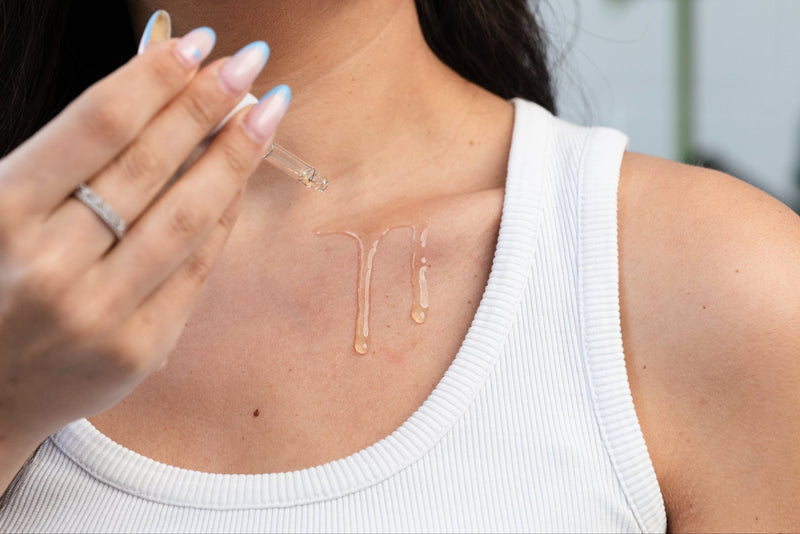
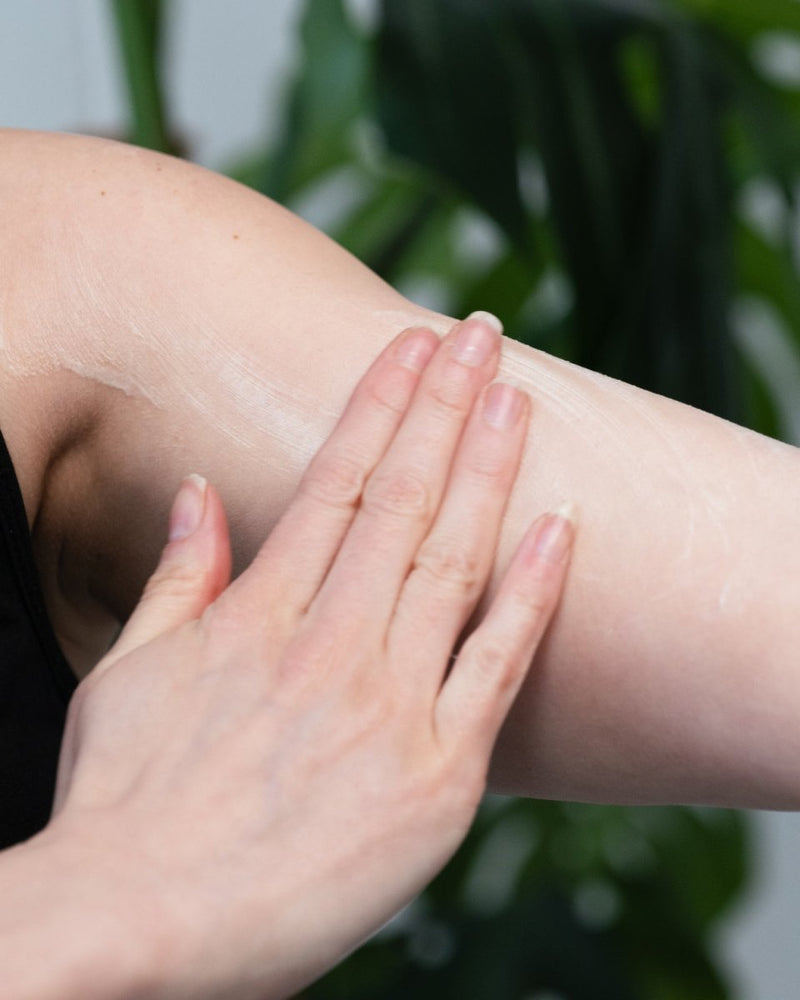
Stomach, chest and upper arms change with the same biology and get even less attention than the face. Regenesis Complex exists for that, applied on damp skin after a shower.
If a routine takes longer than brushing your teeth, you will not do it in February. Two products, forty seconds, twice a day.
06. THE SKIN IN EVOLUTION™ SYSTEM
Here is the full system for completeness, but read the previous section first — if you only ever do Stage 1 and Stage 5, you will have solved most of it.
HYDRATION CONTINUUM GEL
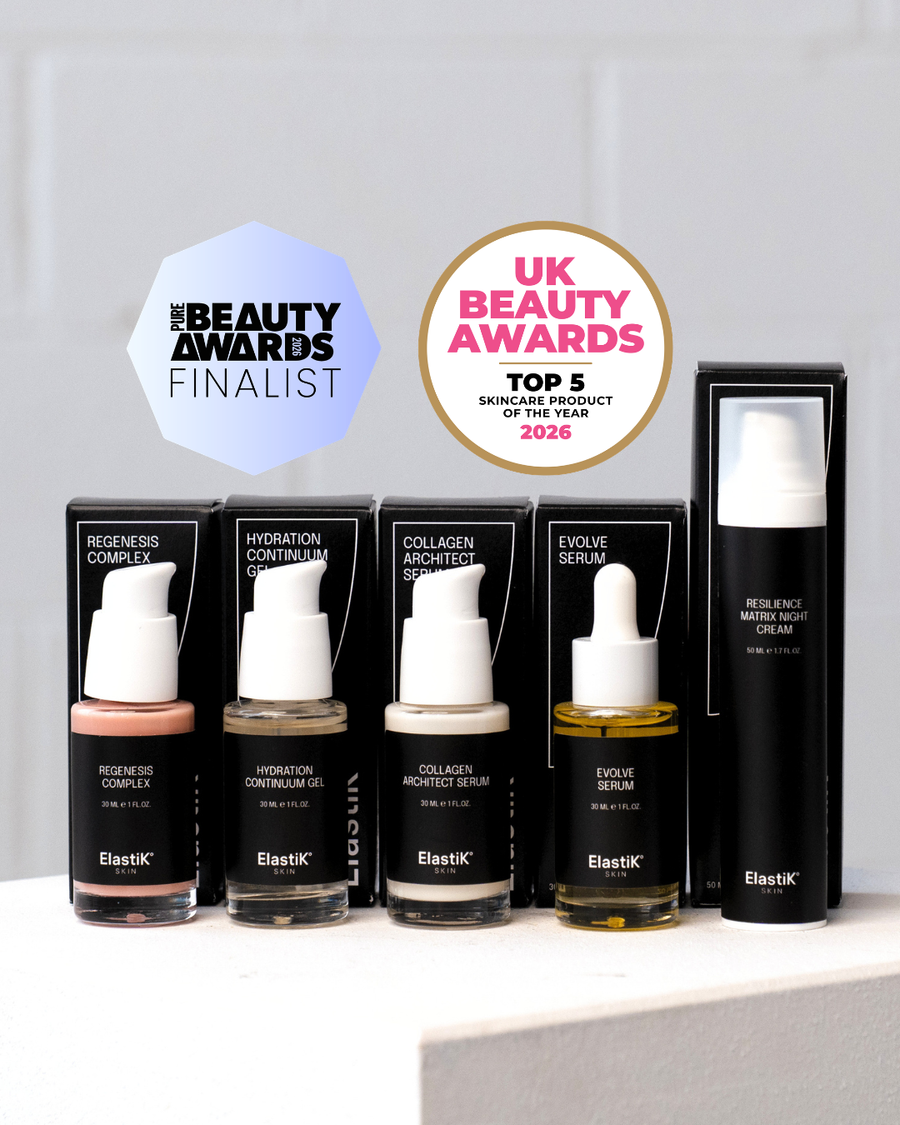
Two forms of hyaluronic acid with sodium PCA and aloe, to help skin hold on to water. Applied to damp skin straight after a shower or shave, twenty seconds every morning. This is the one to start with.
COLLAGEN ARCHITECT SERUM
Multi-weight hyaluronic acid and sodium PCA in a silky serum for the face, neck and chest. Male skin starts with higher collagen density1, which means more to preserve rather than less to worry about. Morning use. Take it onto the neck.
ELASTIK° LED FACIAL MASK
234 LEDs delivering red and near-infrared wavelengths across the full face and neck. A controlled trial of lamp-based red and near-infrared light (not an LED mask) found red and near-infrared light improved fine lines, wrinkles and skin roughness with increased intradermal collagen density on ultrasound.10 Three to five times weekly, hands-free while you do something else.
REGENESIS COMPLEX
Peptide-rich body treatment for stomach, chest, inner arms and neck. Men lose weight disproportionately from the middle, so the stomach is usually where body skin change shows first — and it is the area nobody treats. Applied to damp skin after showering.
EVOLVE SERUM
Bakuchiol, rosehip and evening primrose oil for the evening. Bakuchiol matched retinol for improvement in photoageing in a randomised double-blind trial in the British Journal of Dermatology, with significantly less stinging and scaling.11 On skin that is already being shaved several times a week, that tolerability is the difference between using it and abandoning it. Three to five evenings weekly.
RESILIENCE MATRIX NIGHT CREAM
Ceramide-rich night cream, applied generously as the last thing at night. Ceramide-containing formulations improve water retention and barrier function.6 This is the step that stops the post-shave tightness and the stinging aftershave. Alongside Stage 1, it is the highest-return thing on this list.
07. FAQ
DO MEN GET MOUNJARO FACE LESS THAN WOMEN?
Later rather than less. Thicker skin with higher collagen density1 absorbs the early change, so it becomes visible further into the weight loss. The mechanisms are identical and the eventual extent depends more on how much weight you lose and how fast than on your sex.
WILL A BEARD HIDE IT?
It hides jawline and lower-face change reasonably well. It does nothing for temples, under-eyes or upper cheeks, which is where most people read a face. Growing one is a legitimate short-term option, but be prepared for a jolt if you later shave it off.
WHY DOES MY AFTERSHAVE STING NOW?
Your barrier is compromised, so alcohol that previously sat on an intact surface is now reaching irritated skin. Switch to something alcohol-free, and apply a hydrating layer to damp skin immediately after shaving instead.
IS THERE A MINIMUM ROUTINE THAT ACTUALLY WORKS?
Hydration on damp skin morning and night, and a ceramide cream before bed. Two products, under a minute a day total. That covers the barrier and hydration mechanisms, which is where most of the day-to-day discomfort comes from.
SHOULD I BE WORRIED IF I LOOK GAUNT?
Looking drawn during rapid weight loss is common and usually reflects facial fat loss rather than anything wrong. But if you feel unwell, are losing weight faster than expected, or people are commenting that you look ill, that is worth raising with your GP or prescriber rather than treating as a skincare problem.
DOES ANY OF THIS PUT FACIAL VOLUME BACK?
No. No topical product restores facial fat, and I would not trust anyone claiming otherwise. What they may help with is hydration, texture, barrier function and the appearance of firmness — which affects how the face reads, but is a different claim.
RELATED ARTICLES FROM THE SKIN JOURNAL
Continue reading at elastikskin.com/blogs/the-skin-journal:
SOURCES
All sources are peer-reviewed. Verified at time of publication.
-
Shuster S, Black MM, McVitie E. The influence of age and sex on skin thickness, skin collagen and density. British Journal of Dermatology, 1975;93(6):639–643.
Read the source in the British Journal of Dermatology -
Kılıç S. Facial aging after GLP-1 receptor agonist–induced weight loss: the emerging Ozempic face phenomenon. Journal of Diabetes & Metabolic Disorders, 2025.
Read the source -
Paschou IA, Sali E, Paschou SA, et al. GLP-1RA and the possible skin aging. Endocrine, 2025;89(3):680–685.
Read the source on PubMed Central -
Widgerow AD. Adipose Tissue, Regeneration, and Skin Health: The Next Regenerative Frontier. Aesthetic Surgery Journal Open Forum, 2024;6:ojae117.
Read the source on Oxford Academic -
Rahrovan S, Fanian F, Mehryan P, Humbert P, Firooz A. Male versus female skin: What dermatologists and cosmeticians should know. International Journal of Women's Dermatology, 2018;4(3):122–130.
Read the source -
Kono T, Miyachi Y, Kawashima M. Clinical significance of the water retention and barrier function-improving capabilities of ceramide-containing formulations: A qualitative review. The Journal of Dermatology, 2021;48(12):1807–1816.
Read the source in The Journal of Dermatology -
Bravo B, Correia P, Gonçalves Junior JE, et al. Benefits of topical hyaluronic acid for skin quality and signs of skin aging: From literature review to clinical evidence. Dermatologic Therapy, 2022;35(12):e15903.
Read the source on PubMed Central -
Feng C, Chen X, Yin X, Jiang Y, Zhao C. Matrix Metalloproteinases on Skin Photoaging. Journal of Cosmetic Dermatology, 2024;23(12):3847–3862.
Read the source on PubMed Central -
Tanno O, Ota Y, Kitamura N, et al. Nicotinamide increases biosynthesis of ceramides as well as other stratum corneum lipids to improve the epidermal permeability barrier. British Journal of Dermatology, 2000;143(3):524–531.
Read the source on PubMed -
Wunsch A, Matuschka K. A Controlled Trial to Determine the Efficacy of Red and Near-Infrared Light Treatment in Patient Satisfaction, Reduction of Fine Lines, Wrinkles, Skin Roughness, and Intradermal Collagen Density Increase. Photomedicine and Laser Surgery, 2014;32(2):93–100.
Read the source on PubMed Central -
Dhaliwal S, Rybak I, Ellis SR, et al. Prospective, randomized, double-blind assessment of topical bakuchiol and retinol for facial photoageing. British Journal of Dermatology, 2019;180(2):289–296.
Read the source in the British Journal of Dermatology