ElastiK° Skin | Skin in Evolution™
PROTEIN, WATER AND SKIN: EATING FOR SKIN WHEN YOUR BODY IS CHANGING FAST
By Marc McKee, Founder of ElastiK° Skin
TL;DR: THE ESSENTIAL POINTS
- Eating less makes every meal count for more. GLP-1 medicines reduce appetite and food intake, and a joint expert advisory warns this can lead to too few vitamins and minerals.3
- Protein matters, but it is not a skin treatment. UK guidance is simply to include some protein foods. There is no good evidence that eating extra protein firms loose skin.1,6
- Vitamin C is needed to build collagen. It is a cofactor for the enzymes that stabilise collagen, which is why severe deficiency shows up in the skin.5
- Drinking water helps skin hydration a little, mostly if you drink too little. The research is small and early.7,8
- This is not a diet plan. If you are on a weight-loss medicine, your prescriber or a registered dietitian is the right person to set targets for you.1,4
"What should I be eating for my skin?"
It is one of the questions I am asked most, usually by someone a few months into a GLP-1 who has noticed their skin looks tired, dry or looser than it did.
The internet answers it with collagen powders, "glow" smoothies and very confident advice. Most of it goes well beyond what the evidence shows.
Why this matters now.
When your appetite drops, you are building and maintaining your body from less food. The quality of what you do eat matters more than it did when portions were bigger.
This article covers what protein, vitamin C and water actually do for skin, what the evidence does and does not support, and where skincare fits. It is general information, not a meal plan. I am not a dietitian, and I am not going to give you calorie or gram targets.
01. WHY WHAT YOU EAT MATTERS MORE WHEN YOU EAT LESS
APPETITE GOES DOWN, NEEDS DO NOT
In 2025, four US obesity and nutrition organisations published a joint advisory on nutrition alongside GLP-1 therapy. It describes significant reductions in appetite and energy intake, and reports that GLP-1 medicines reduce energy intake by 16% to 39% compared with placebo.3
The same advisory warns that a large, rapid drop in intake can lead to insufficient intakes of essential vitamins and minerals.3 Skin is made and repaired from those same nutrients.
NOT ALL THE WEIGHT LOST IS FAT
The advisory notes that in the STEP 1 trial of semaglutide, about 38% of the weight lost was lean body mass, and it highlights protein intake and strength training as priorities for protecting muscle.3 That is mainly a muscle and strength point, not a skin one. It is a good reason to take protein seriously, though.
WHAT THE NHS SAYS
The NHS page on tirzepatide (Mounjaro) says you need to follow a healthy, balanced diet while you take it.4 For most people, the Eatwell Guide is the starting point for what that looks like.1
A smaller appetite is the point of the medicine. It also means there is less room for food that does nothing for you.
02. PROTEIN: WHAT IT DOES AND WHAT IT DOES NOT
WHAT UK GUIDANCE ACTUALLY SAYS
The Eatwell Guide advises eating some beans, pulses, fish, eggs, meat and other protein foods, with at least two portions of fish a week, one of them oily.1 The British Dietetic Association's advice for older adults is to have at least one portion of protein with each meal.2 Neither gives a skin-specific amount, because there is not one.
The US advisory suggests protein needs may be higher during active weight loss.3 How much is right for you depends on your health, kidneys, medicines and activity, which is exactly why it is a conversation for your prescriber or a registered dietitian rather than a blog.
THE HONEST LIMIT
A review in Dermato-Endocrinology describes the link between nutrition and skin ageing as a "controversial and conflicting subject".6 Eating enough protein supports your body as a whole. There is no good evidence that eating more than you need tightens loose skin or reverses the effects of rapid weight loss.
A practical habit, not a target.
If you are struggling to eat much, put the protein part of the meal first on the plate and eat it first. Many people on GLP-1 medicines fill up quickly, and it is easy to finish on the bread.
03. VITAMIN C AND COLLAGEN
WHY YOUR SKIN NEEDS IT
Collagen is the main structural protein in the dermis. A review in Nutrients explains that vitamin C is a cofactor for the proline and lysine hydroxylases, the enzymes that stabilise the collagen molecule, and that it also promotes collagen gene expression.5 The same review notes that scurvy, severe vitamin C deficiency, is characterised by skin fragility, bleeding gums and poor wound healing.5 The Dermato-Endocrinology review describes the same cofactor role.6
WHAT THE EVIDENCE CAN AND CANNOT SAY
The Nutrients review is careful here. It notes that many diet studies showing benefits for skin appearance involved a high intake of fruit and vegetables, but that no studies have measured vitamin C intake alongside age-related skin changes.5 So the evidence that vitamin C from food improves how skin looks is indirect.
The practical answer is the boring one. The Eatwell Guide advises at least five portions of a variety of fruit and vegetables a day.1 Peppers, citrus fruit, berries, kiwi and leafy greens all contribute vitamin C. If you are eating less, choosing them deliberately makes sense.
You cannot eat your way out of loose skin. You can make sure you are not short of what skin is built from.
04. WATER AND SKIN: THE EVIDENCE IS THINNER THAN YOU THINK
HOW MUCH THE NHS SUGGESTS
The Eatwell Guide says the government recommends 6 to 8 cups or glasses of fluid a day, and that most people should drink enough for their urine to be a clear pale yellow.1 Water, lower-fat milk, lower-sugar drinks, tea and coffee all count. You may need more if you are ill, physically active for long periods or somewhere hot.9
WHAT DRINKING MORE DOES FOR SKIN
A 2018 systematic review in Skin Research and Technology concluded that additional dietary water may increase hydration of the skin's outer layer, but that the mechanism is unknown and more research is needed.8
In one small study of 49 young women, adding about two litres of water a day for 30 days improved measures of skin hydration, most clearly in those who usually drank less.7 It was a small study in women only, with no control group, so treat it as a hint rather than proof.
WHERE GLP-1 MEDICINES COME IN
Nausea, vomiting and diarrhoea are common side effects. The US advisory notes that dehydration from them can cause acute kidney injury, and it advises eating smaller, more frequent meals while drinking adequate fluids.3 If you cannot keep fluids down, speak to your pharmacist, GP or prescriber.
| What people say | What the evidence shows |
|---|---|
| "Drink more water and your loose skin will tighten" | No evidence. Water intake has small effects on surface hydration at most.7,8 |
| "High protein firms skin" | No good evidence. Enough protein supports the body generally; nutrition and skin ageing research is mixed.6 |
| "Vitamin C builds collagen" | Partly true. It is essential for making stable collagen, but food studies on skin appearance are indirect.5 |
| "Collagen drinks give you new collagen" | Mixed. Some trials report benefits, but many are small and have risk-of-bias concerns.10 |
| "Fluids only count if it is water" | Not true. Tea, coffee, lower-fat milk and lower-sugar drinks count too.9 |
05. WHAT ABOUT COLLAGEN SUPPLEMENTS?
I get asked this every week, so here is the fair version.
A 2023 meta-analysis in Nutrients pooled 26 randomised trials with 1,721 participants taking hydrolysed collagen. It reported improvements in skin hydration and elasticity compared with placebo.10 The authors also flagged small sample sizes, different products and measurements, and risk-of-bias concerns in several trials, and called for larger studies.10
None of those trials was in people losing weight quickly on GLP-1 medicines. Collagen powder is also a protein, so if it replaces a meal you are struggling to eat, you are not adding anything. If you want to try one, check it with your pharmacist first, especially if you take other medicines.
THE HONEST SUMMARY
Food gives skin the raw materials. It does not give skin instructions. Eating well stops you being short of what skin needs. It will not, on its own, change skin that has been stretched for years.
06. WHERE SKINCARE FITS
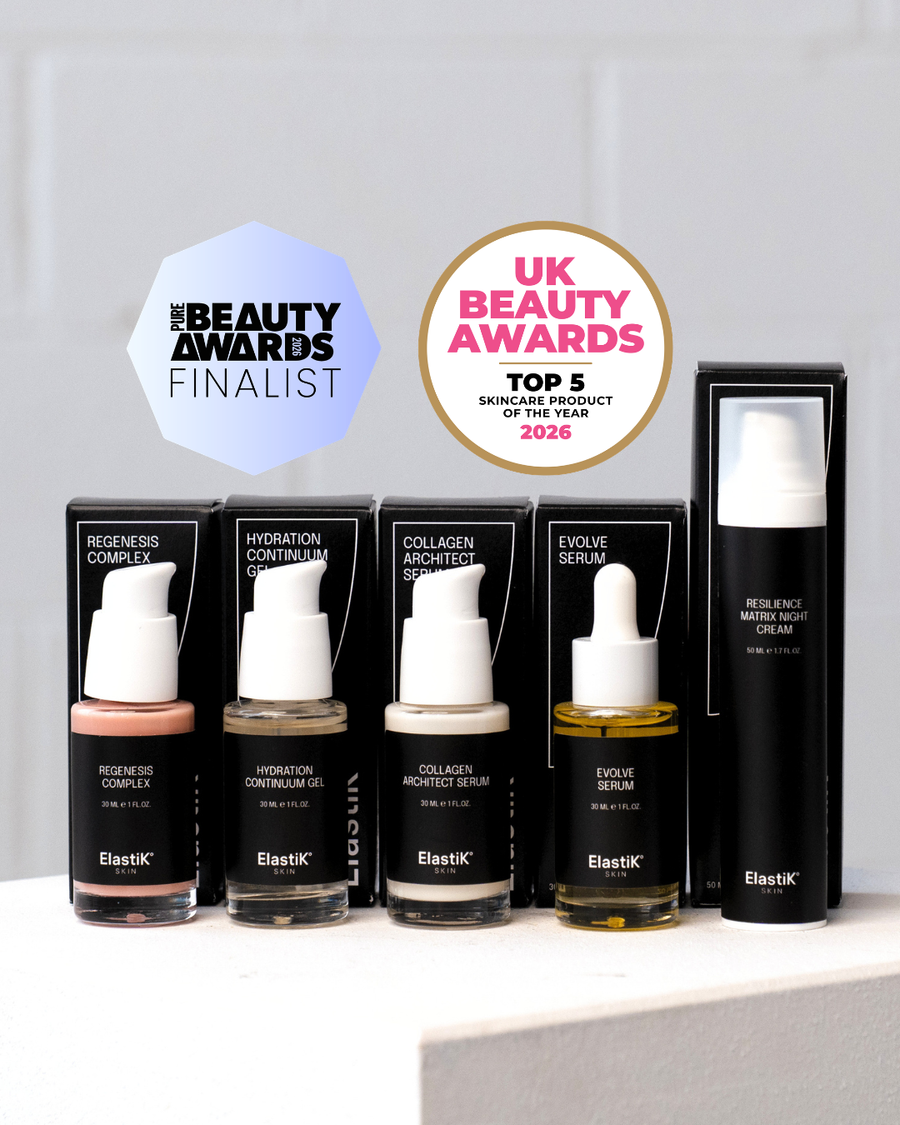
Diet works from the inside. Skincare looks after the outer layer you can see and feel. For skin that feels dry and tight during weight loss, two stages do most of the work.

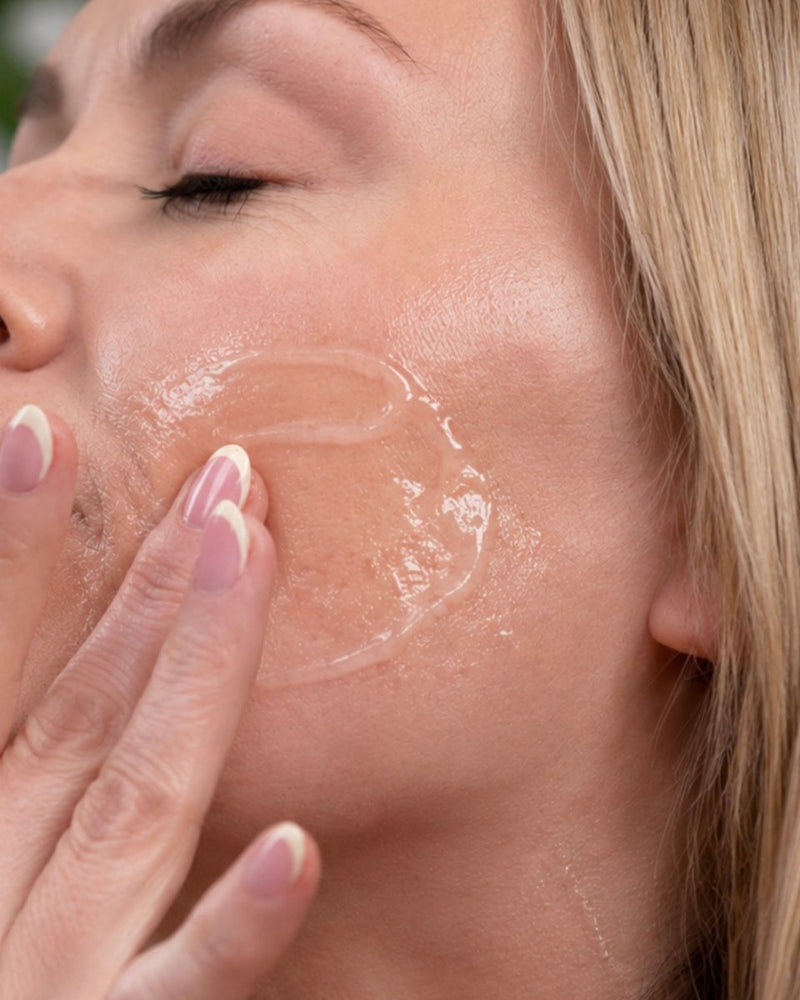
HYDRATION CONTINUUM GEL
Two forms of hyaluronic acid with sodium PCA and aloe leaf juice, applied straight after your morning shower to the face, neck, chest and arms.
Drinking more water has only small, uncertain effects on skin hydration,7,8 so this step puts water-binding ingredients directly on the skin instead. It is a light gel, which matters if heavier creams feel like too much on top of everything else you are managing.

RESILIENCE MATRIX NIGHT CREAM
Shea and cocoa butter with plant glycosphingolipids, as you get into bed, on the face, neck and chest.
When you are eating less and skin feels drier and tighter than it used to, a richer cream last thing at night helps it feel comfortable until morning. It works on the outside; it does not replace eating well.
In our own pre-launch trial, 11 of 11 participants said their skin felt more hydrated after six weeks, and 9 of 11 said it felt more comfortable. It was small, so read the full details on our evidence page.
07. FAQ
DOES PROTEIN HELP LOOSE SKIN AFTER WEIGHT LOSS?
Not directly. Enough protein supports your body during weight loss, including muscle.3 There is no good evidence that extra protein tightens loose skin.6
HOW MUCH PROTEIN SHOULD I EAT ON MOUNJARO OR WEGOVY?
Ask your prescriber or a registered dietitian. Needs vary with your health, kidney function and activity. UK general guidance is to include protein foods as part of a balanced diet.1
WILL DRINKING MORE WATER HELP MY SKIN?
Possibly a little, especially if you usually drink too little.7,8 It will not tighten skin. Aim for the NHS guide of 6 to 8 cups or glasses a day, or enough for pale yellow urine.1
WHAT FOODS ARE GOOD FOR COLLAGEN?
Your body builds collagen from protein, and needs vitamin C to stabilise it.5 Protein foods plus plenty of fruit and vegetables cover both.1
DO COLLAGEN SUPPLEMENTS WORK?
The evidence is mixed. A 2023 meta-analysis reported benefits for hydration and elasticity but noted risk-of-bias concerns and called for larger trials.10 Check with a pharmacist before starting one.
I CAN BARELY EAT. WHAT SHOULD I DO?
Tell your prescriber. Very low intake, ongoing sickness or signs of dehydration are worth raising at any point, not just at your next review.3
RELATED ARTICLES FROM THE SKIN JOURNAL
SOURCES
All sources checked in October 2026.
-
NHS. The Eatwell Guide. NHS website, page last reviewed 29 November 2022.
Read the source on the NHS website -
British Dietetic Association. Eating, drinking and ageing well. BDA Food Fact Sheet, 2023.
Read the source on the BDA website -
Mozaffarian D, Agarwal M, Aggarwal M, et al. Nutritional priorities to support GLP-1 therapy for obesity: A joint Advisory from the American College of Lifestyle Medicine, the American Society for Nutrition, the Obesity Medicine Association, and The Obesity Society. Obesity, 2025;33(8):1475–1503.
Read the source on PubMed Central -
NHS. Tirzepatide: a medicine to manage type 2 diabetes and treat obesity. NHS website, page last reviewed 15 May 2026.
Read the source on the NHS website -
Pullar JM, Carr AC, Vissers MCM. The Roles of Vitamin C in Skin Health. Nutrients, 2017;9(8):866.
Read the source on PubMed Central -
Schagen SK, Zampeli VA, Makrantonaki E, Zouboulis CC. Discovering the link between nutrition and skin aging. Dermato-Endocrinology, 2012;4(3):298–307.
Read the source on PubMed Central -
Palma L, Tavares Marques L, Bujan J, Monteiro Rodrigues L. Dietary water affects human skin hydration and biomechanics. Clinical, Cosmetic and Investigational Dermatology, 2015;8:413–421.
Read the source -
Akdeniz M, Tomova-Simitchieva T, Dobos G, Blume-Peytavi U, Kottner J. Does dietary fluid intake affect skin hydration in healthy humans? A systematic literature review. Skin Research and Technology, 2018;24(3):459–465.
Read the source on PubMed -
NHS. Water, drinks and hydration. NHS website, page last reviewed 17 May 2023.
Read the source on the NHS website -
Pu SY, Huang YL, Pu CM, Kang YN, Hoang KD, Chen KH, Chen C. Effects of Oral Collagen for Skin Anti-Aging: A Systematic Review and Meta-Analysis. Nutrients, 2023;15(9):2080.
Read the source
This article is general information, not medical advice. ElastiK° products are cosmetics and support the appearance of skin; they do not treat medical conditions.