ElastiK° Skin | Skin in Evolution™
DOES AN LED FACE MASK ACTUALLY WORK? WHAT THE EVIDENCE SAYS
By Marc McKee, Founder of ElastiK° Skin
TL;DR: THE ESSENTIAL POINTS
- Red and near-infrared light do have real research behind them. The process is called photobiomodulation: light is absorbed in the cell's mitochondria and changes how the cell behaves.2
- The evidence for skin ageing is promising but not strong. A systematic review of 31 randomised trials gave its best grade (B) to acne, cold sores and wound healing. Other uses scored lower.1
- Most of the best-known results come from lamps and clinic units, not home masks. The most-quoted trial used large lamp units, twice a week, for 30 sessions.3
- Home mask studies exist, but they are small and often linked to the maker. One mask study had 20 people, no control group and authors connected to the manufacturer.4
- Eyes and pregnancy matter. Use the eye protection and do not stare into the LEDs.7 The ElastiK° mask is not for use during pregnancy.
I get asked about LED masks more than almost anything else.
Usually the question is: "Is it worth it, or is it a gadget?" It is a fair question. A lot of the marketing around LED masks is louder than the science.
We sell one, as Stage 3 of the Skin in Evolution™ System. That is exactly why I want to be careful here. If I am going to put an LED mask in front of people whose skin is changing fast, I need to be clear about what the research shows, where it is thin, and what it does not show at all.
The short version.
LED light is not magic and it is not nonsense. There is a real biological mechanism and some decent trials. But the evidence is smaller, younger and more industry-linked than the adverts suggest.
This article covers how LED light works on skin, what the studies found and what they used, the difference between a lamp and a mask, what is not proven, and how to use a mask safely.
01. WHAT AN LED MASK ACTUALLY DOES
LED stands for light-emitting diode. An LED mask is a shell lined with small lights held close to the face. There is no heat and no laser. The light simply shines on the skin for a set time.
THE MECHANISM: PHOTOBIOMODULATION
The scientific term is photobiomodulation, sometimes called low-level light therapy. A review in Seminars in Cutaneous Medicine and Surgery explains that red and near-infrared light is absorbed by molecules in the mitochondria, the energy-producing parts of the cell. That absorption is linked to more cellular energy (ATP), more nitric oxide and blood flow, and activation of signalling pathways involved in repair.2
The same review lists wrinkles, acne scars and burn healing among the areas where benefits have been reported.2 It is a review written by researchers in the field, so it leans positive. It is a good explanation of the mechanism, not proof that every device works.
THE COLOURS AND WHAT THEY ARE USED FOR
| Light | Typical wavelength | What it is mainly studied for |
|---|---|---|
| Red | Around 630–660nm | Fine lines, skin texture and the look of skin ageing3,4,5 |
| Near-infrared | Around 810–850nm | Reaches deeper than red. Studied with red light in skin ageing and in healing2,3 |
| Blue | Around 415nm | Acne-prone skin, one of the better-supported uses of LED overall1 |
| Amber | Around 590nm | Compared with red light in one trial on wrinkles around the eyes5 |
LED light changes how skin cells behave. It does not add or remove anything from your face. That is why any results are gradual, and why consistency matters more than the device.
02. WHAT THE EVIDENCE ACTUALLY SAYS
I am going to be blunt, because this category is full of overpromising. Here is what the research looks like when you read the studies rather than the headlines.
THE BIG PICTURE: A SYSTEMATIC REVIEW
In 2018, dermatologists published a systematic review of randomised controlled trials of LEDs in skin conditions. They found 31 trials. Acne, cold sores and shingles, and acute wound healing received a grade B recommendation. Every other skin use, which includes skin ageing, received a grade C or D.1
The reviewers named the problems plainly: many studies had fewer than 20 people, many were not blinded, many had no sham (fake light) group, and treatment settings varied widely. They still concluded LEDs were low-risk and worth using and studying further.1
THE STUDY EVERYONE QUOTES
The most-cited skin trial is from 2014. It involved 136 volunteers. Most were treated with red or broadband light twice a week for 30 sessions, and a smaller group acted as controls.3
After 30 sessions, the treated groups showed less skin roughness and higher collagen density measured by ultrasound, and blinded reviewers of photographs judged fine lines and wrinkles to have improved compared with the controls.3
The caveats matter. The light came from large lamp units, some full-body, not a face mask. The study was also funded by the company behind the units.3
A RANDOMISED TRIAL AROUND THE EYES
A 2023 trial treated 137 women aged 40 to 65 with red light on one side of the face and amber light on the other: ten sessions over four weeks. Wrinkle volume around the eyes fell by 31.6% on the red side and 29.9% on the amber side. Neither colour changed skin hydration or elasticity.5
The visible change was in fine lines. The firmness measures did not move.
A STUDY ON AN AT-HOME MASK
A 2023 study did test a home LED mask: 20 volunteers, red light, 12 minutes twice a week for three months. It reported less wrinkle depth, better firmness and more dermal density by ultrasound.4
It also had no control group, people carried on with their usual skincare, and the authors included the chief executive of the company that makes the mask.4 It shows a home mask is a reasonable thing to study. It does not settle the question.
HOME DEVICES MORE BROADLY
A systematic review of home-use light devices for medical (non-cosmetic) uses found 11 studies, mostly with positive results, and said proper randomised trials are still needed before anyone can draw firm conclusions.6
| Study | What was used | What it found | The catch |
|---|---|---|---|
| Wunsch & Matuschka, 20143 | Lamp units, 30 sessions | Fewer fine lines, smoother skin, more collagen density on ultrasound | Not a mask. Industry funded |
| Mota et al., 20235 | Red vs amber LED, 10 sessions | About 30% less wrinkle volume around the eyes | No change in hydration or elasticity. Short follow-up |
| Couturaud et al., 20234 | Home red LED mask, 3 months | Improvements in wrinkles, firmness and density | 20 people, no control group, manufacturer involved |
| Jagdeo et al., 20181 | Review of 31 trials | Best evidence for acne, cold sores, wounds | Skin ageing graded C or D. Many small trials |
03. LAMP VS MASK: WHY IT MATTERS
When you see "studies show LED boosts collagen", it is worth asking which device was used. Clinic panels, lamp units and home masks differ in power, in distance from the skin and in the dose of light the skin receives. The 2018 review listed varied treatment settings as one of the main weaknesses of the evidence.1
The authors of the home mask study made a similar point: there is no standard LED protocol and no comparative studies validating the doses used.4 So a result from a lamp in a clinic does not automatically transfer to a mask at home, in either direction.
What I would look for in any mask.
Clear wavelengths (red and near-infrared for skin ageing), a timer, proper eye protection, coverage of the areas you care about, and honest instructions about who should not use it.
04. WHAT IS NOT PROVEN
This is the section most LED adverts leave out.
- Tightening loose skin. No LED study has shown it can remove or lift excess skin after major weight loss, pregnancy or menopause. The firmness results that exist are modest, and one randomised trial found no change in elasticity.5
- Results in people losing weight quickly. None of the studies above looked at people on GLP-1 medicines or going through rapid weight change.
- Long-term results. Follow-up in these studies is weeks or months, not years.3,4,5
- That more is better. Longer or more frequent sessions have not been shown to give better results. Follow the instructions.
The realistic promise of an LED mask is skin that looks a little smoother and more even over months of regular use. If anyone promises you a lift, ask them for the study.
05. SAFETY: EYES, PREGNANCY AND WHO SHOULD NOT USE ONE
EYES
In 2019 one well-known brand recalled its light therapy acne mask in the UK and Ireland over a theoretical risk of eye injury in a small group of people with certain underlying eye conditions or taking medicines that make the eyes more sensitive to light.7 The company described effects on vision as rare, mild and temporary, but it is a useful reminder: masks shine bright light close to the eyes.
Wear the eye protection supplied, keep your eyes closed, and never look directly into the LEDs. If you have an eye condition, or take a medicine that increases light sensitivity, ask your GP, optometrist or pharmacist first. Stop if your eyes feel uncomfortable.
PREGNANCY
LED masks have not been studied in pregnancy, and the ElastiK° mask is not suitable for use while pregnant.
OTHER REASONS NOT TO USE A MASK
The ElastiK° mask instructions also say not to use it if you have epilepsy, a thyroid condition or take thyroid medication, have a light allergy, take medicines that cause photosensitivity, have broken or injured skin, or for children. If you are unsure, check with your GP or pharmacist first.
Across the randomised trials in the 2018 review, side effects were few.1
06. HOW WE USE LED IN THE SKIN IN EVOLUTION™ SYSTEM
We include LED because the mechanism is real and the early evidence is encouraging, not because it does anything on its own that skincare cannot. It is one stage of a routine, not the routine.

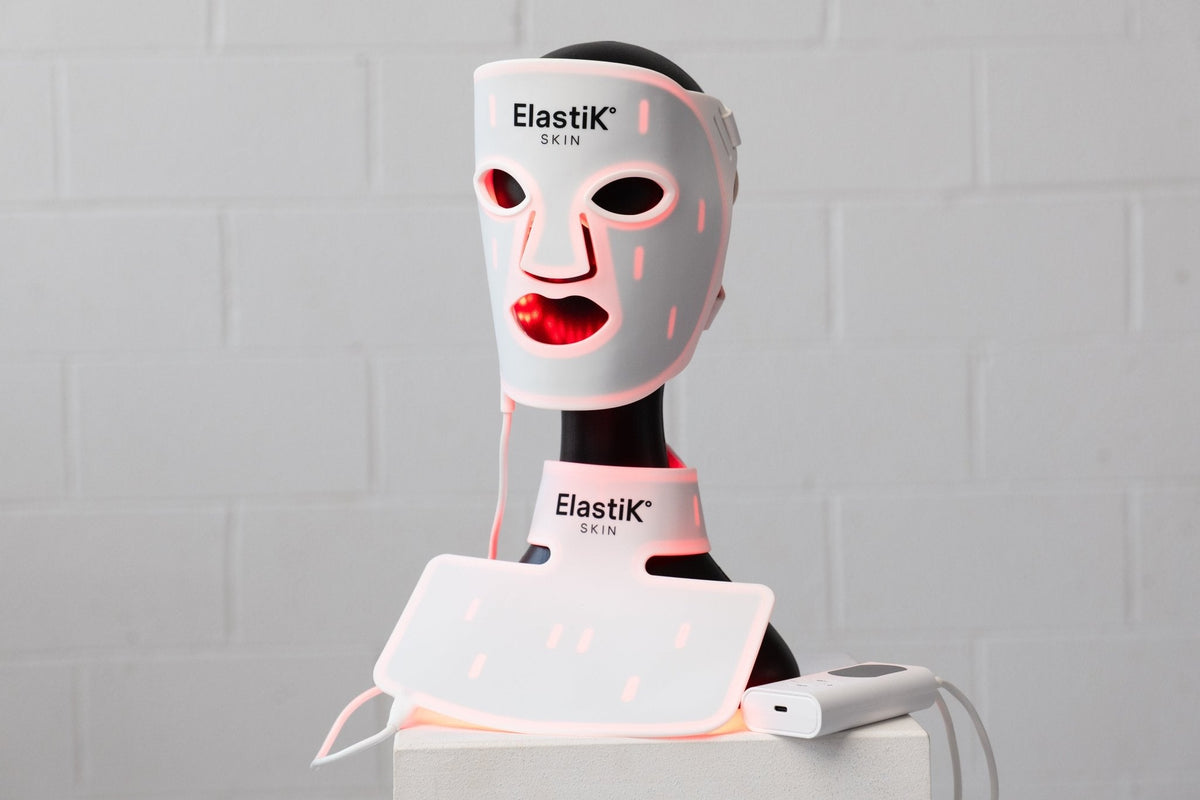
ELASTIK° SKIN LED FACE + NECK MASK
234 LEDs: 114 in the face mask and 120 in the neck piece, with red (630nm), near-infrared (830nm) and blue (415nm) light plus combined modes. Use it on clean, dry skin in the evening before your skincare, or in the morning before anything else. Start at 5 minutes and build up to 10. Not suitable during pregnancy. UK delivery only.
It uses red and near-infrared light, the ranges most of the skin-ageing research has looked at,3,4 covers the neck as well as the face, and comes with silicone eye protectors and a timer. To be clear: no study has been carried out on the ElastiK° mask itself. The research above was done on other devices, so treat it as an optional, gradual step alongside your skincare, not a promise of results.
The System: LED Light Therapy · ElastiK° Skin
Our own pre-launch trial looked at how skin felt with the topical routine: 11 participants over six weeks. All 11 said their skin felt more hydrated, and 9 of 11 said it felt more comfortable. You can read the details on our evidence page.
07. FAQ
DO LED FACE MASKS ACTUALLY WORK?
There is reasonable early evidence that red and near-infrared light can improve the look of fine lines and skin texture, but the trials are small and often industry funded.1,3,4 They are not a replacement for skincare or sun protection.
HOW LONG BEFORE I SEE RESULTS FROM AN LED MASK?
Studies measured changes after about four weeks to three months of regular sessions.4,5 Take photos in the same light every month so you can judge fairly.
CAN AN LED MASK TIGHTEN LOOSE SKIN AFTER WEIGHT LOSS?
No study shows that. LED may support the look of smoother skin, but it cannot remove excess skin. That is a conversation for a surgeon.
IS RED LIGHT THERAPY SAFE FOR YOUR EYES?
Used as directed with eye protection, side effects in studies have been few.1 But one brand recalled a mask over a theoretical eye risk for people with some eye conditions or light-sensitising medicines.7 Never stare into the LEDs, and ask an optometrist if you have an eye condition.
CAN I USE AN LED MASK WHILE PREGNANT OR BREASTFEEDING?
Not during pregnancy. If you are breastfeeding, check with your midwife or GP before starting.
IS A HOME MASK AS GOOD AS A CLINIC TREATMENT?
Nobody can say for certain. The devices differ in power and dose, and no standard protocol exists.1,4 A home mask is easier to use often, which counts for something.
RELATED ARTICLES FROM THE SKIN JOURNAL
SOURCES
All sources checked in October 2026.
-
Jagdeo J, Austin E, Mamalis A, Wong C, Ho D, Siegel DM. Light-emitting diodes in dermatology: A systematic review of randomized controlled trials. Lasers in Surgery and Medicine, 2018;50(6):613–628.
Read the source -
Avci P, Gupta A, Sadasivam M, Vecchio D, Pam Z, Pam N, Hamblin MR. Low-level laser (light) therapy (LLLT) in skin: stimulating, healing, restoring. Seminars in Cutaneous Medicine and Surgery, 2013;32(1):41–52.
Read the source on PubMed -
Wunsch A, Matuschka K. A Controlled Trial to Determine the Efficacy of Red and Near-Infrared Light Treatment in Patient Satisfaction, Reduction of Fine Lines, Wrinkles, Skin Roughness, and Intradermal Collagen Density Increase. Photomedicine and Laser Surgery, 2014;32(2):93–100.
Read the source on PubMed Central -
Couturaud V, Le Fur M, Pelletier M, Granotier F. Reverse skin aging signs by red light photobiomodulation. Skin Research and Technology, 2023;29(7):e13391.
Read the source on PubMed Central -
Mota LR, Duarte ISD, Galache TR, et al. Photobiomodulation Reduces Periocular Wrinkle Volume by 30%: A Randomized Controlled Trial. Photobiomodulation, Photomedicine, and Laser Surgery, 2023;41(2):48–56.
Read the source -
Gavish L, Houreld NN. Therapeutic Efficacy of Home-Use Photobiomodulation Devices: A Systematic Literature Review. Photobiomodulation, Photomedicine, and Laser Surgery, 2019;37(1):4–16.
Read the source -
Powell S. Eye injury risk prompts recall of Neutrogena light therapy acne mask. Optometry Today (Association of Optometrists), 22 July 2019.
Read the source
This article is general information, not medical advice. ElastiK° products are cosmetics and support the appearance of skin; they do not treat medical conditions.