ElastiK° Skin | Skin in Evolution™
MENOPAUSE ITCHY SKIN: WHY IT HAPPENS AND WHAT HELPS
By Marc McKee, Founder of ElastiK° Skin
TL;DR: THE ESSENTIAL POINTS
- Itchy skin is a recognised menopause symptom. The NHS lists dry and itchy skin among the symptoms of perimenopause and menopause, and says itch after menopause usually gets better over time.1,2
- It usually comes with dryness. Falling oestrogen is linked to skin losing more water and holding less of it, which leaves it dry and easily irritated.3,5
- Small daily habits help. Cooler, shorter showers, no harsh soap, moisturiser straight after washing and soft fabrics all help.2,3,6
- Use unperfumed products while skin is itchy. That is NHS advice, and it applies to our products too: they contain fragrance.2
- Some itch is not menopause. If it is severe, all over your body, keeping you awake or not improving, see your GP.2
“I thought I was going mad.” Women in our community say it about the itch more than almost any other menopause change.
Shins that itch in bed. Arms that feel prickly after a shower. Skin that suddenly reacts to a body lotion you have used for years. Nothing to see, and yet it will not stop.
It rarely gets talked about next to hot flushes and sleep. But it is common, there is a reason for it, and most of what helps is simple.
Where this comes from.
This article draws on NHS guidance, UK dermatology reviews and what women in our community tell us every day. It is not medical advice, and if your itch is severe or worrying you, your GP is the right first stop.
This article covers why menopause can make skin itch, what makes it worse, what helps, where HRT fits and when an itch needs checking.
01. HOW COMMON IS IT?
The NHS lists dry and itchy skin among the symptoms of perimenopause and menopause.1 Its itchy skin guidance says itch is also common after the menopause and usually gets better over time.2
A 2026 systematic review of menopause and skin conditions highlights one study where dry skin was found in 78% and itch in 46% of 150 postmenopausal women.4 That is one study in one group of women, so the exact numbers will not apply everywhere. It does show this is far from rare.
If your skin has started itching in your forties or fifties and nobody can tell you why, you are not imagining it, and you are not alone.
02. WHY MENOPAUSE MAKES SKIN ITCH
OESTROGEN HELPS SKIN HOLD WATER
A UK dermatologist's review explains that oestrogen helps the outer layer of skin hold water, so as levels fall, skin holds less.5 A 2022 review in Clinical and Experimental Dermatology adds that oestrogen is implicated in transepidermal water loss, which is the water that escapes through the skin.3
DRY SKIN IS ITCHY SKIN
The same review describes itching as frequent after menopause, commonly alongside dry skin.3 In the study highlighted by the 2026 review, dry skin and itch were both common in the same group of women.4
LESS COLLAGEN, THINNER SKIN
Skin also loses collagen quickly after menopause, with nearly a third lost in the first five years.3 We explain the collagen side in Menopause Skin Changes: What Happens to Collagen, and What Helps.
IF YOU ARE ALSO LOSING WEIGHT
Many women in our community are going through menopause and taking a GLP-1 medicine at the same time. The NHS lists itchy or red skin where you inject among the common side effects of semaglutide.9 If you are on a GLP-1 medicine and itch is new or getting worse, mention it at your medication review so it can be checked. We cover the overlap in HRT and GLP-1 Together: What It Means for Your Skin.
03. WHAT MAKES IT WORSE
Most menopause itch is made worse by everyday habits that skin used to cope with. The NHS and the dermatology review point to the same culprits.2,3
| Habit | Swap | Why |
|---|---|---|
| Long, hot showers or baths | Shorter, cool or lukewarm | NHS itchy skin advice2, and reduced bathing time is a recommended measure3 |
| Soap and perfumed shower gel | A gentle, unperfumed wash or an emollient | Soap is listed as an irritant to avoid,3 and the NHS advises against perfumed soaps2 |
| Moisturising when you remember | As soon as you have patted dry | Emollients work best straight after washing6 |
| Wool, synthetics, tight clothes | Loose cotton or silk | NHS itchy skin advice2 |
| Scratching | Pat or tap, or hold a cool damp towel on it | NHS itchy skin advice2 |
| Dry, heated rooms | A humidifier in the bedroom | Listed among general measures for itch after menopause3 |
04. WHAT HELPS
MOISTURISE EVERY DAY, AT THE RIGHT TIME
The dermatology review lists a low-pH emollient at least once a day among the general measures for itch after menopause.3 The NHS says emollients are best applied after washing, as soon as skin is patted dry, and smoothed on in the direction of hair growth rather than rubbed in. Thicker, greasier products such as ointments are good for very dry skin and night-time.6
KEEP IT UNPERFUMED WHILE SKIN IS ITCHY
The NHS advice for itchy skin is to use an unperfumed moisturiser or emollient regularly, and laundry products made for sensitive skin.2
KEEP NAILS SHORT
Short, smooth nails do less damage if you do scratch. Both the NHS and the dermatology review mention it.2,3
The one-week test.
Turn the shower down a notch, swap soap for a gentle unperfumed wash, and moisturise within a few minutes of drying, every day for a week. It is a simple place to start, and it costs nothing.
05. WHERE HRT FITS
This is a medical decision, and not mine to make for anyone.
The Clinical and Experimental Dermatology review notes that oestrogen applied through the skin has been shown to reduce water loss and improve barrier function, and it lists oestrogen HRT alongside general measures for itch after menopause.3
HRT is prescribed for menopause symptoms and has benefits and risks that depend on you. The decision should be made with your GP.7,8 If itch is one of several symptoms affecting your life, it is worth mentioning at that appointment.
06. WHEN AN ITCH IS NOT MENOPAUSE
Around menopause, itch commonly comes with dryness.3,4 But itch can have other causes, and the NHS says that, less commonly, it can be a sign of thyroid, liver or kidney problems.2
The NHS advises seeing a GP if itchy skin:2
- is affecting your daily life
- does not get better with self-care or keeps coming back
- comes with a new rash, lump or swelling you are worried about
- is all over your body
- is severe
- happens during pregnancy
Itching in and around the vagina is also a recognised menopause symptom.1 It is a different problem from body itch and worth raising with your GP or practice nurse, rather than treating with body skincare.
07. A ROUTINE FOR DRY, MENOPAUSAL SKIN
The Skin in Evolution™ System was made for skin going through rapid change, including perimenopause and menopause, GLP-1 and other weight loss, and after pregnancy. For dry menopausal skin, these are the steps that matter most.
Please read this first.
Our products contain fragrance (listed as parfum), and in some of them fragrance components come from natural essential oils. Natural fragrance can still irritate itchy skin, and the NHS advice for itchy skin is to use unperfumed products.2 If your skin is itchy, red or reactive right now, stick to a plain unperfumed emollient until it settles. When it has calmed, patch test before using our products on larger areas.

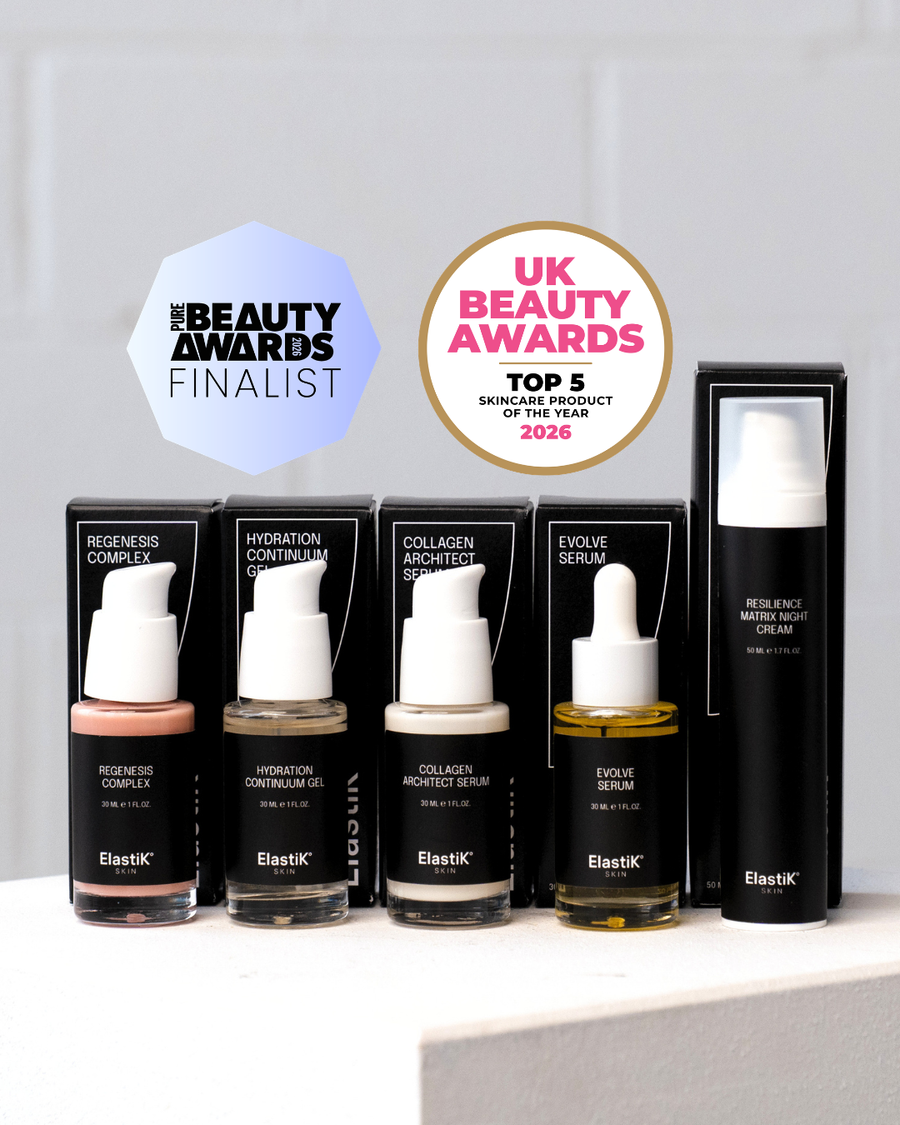
HYDRATION CONTINUUM GEL
Two forms of hyaluronic acid with sodium PCA and aloe, on the face, neck, décolletage and arms.
Timing matters. A light gel that goes on as soon as skin is patted dry makes it easy to moisturise every single day.

PEPTIDE SOLSTICE DAY CREAM
A lightweight peptide moisturiser with hexapeptide-11, hyaluronic acid and jojoba oil, for the face and neck each morning.
If your face feels tight and dry through the day, this gives it a daytime moisturiser. Follow with sunscreen when UV is 3 or higher.

RESILIENCE MATRIX NIGHT CREAM
A rich cream with shea and cocoa butter and plant glycosphingolipids, applied as you get into bed. Face, neck and décolletage.
This is the richest step in the routine, and it supports the barrier while you sleep.
In our small pre-launch trial, 11 people used the routine for six weeks. All 11 said their skin felt more hydrated, and 9 of 11 said it felt more comfortable. That is about how skin felt, not about treating itch, and the details are on our evidence page.
08. FAQ
CAN MENOPAUSE CAUSE ITCHY SKIN?
Yes. The NHS lists dry and itchy skin among the symptoms of perimenopause and menopause.1 Falling oestrogen is linked to skin losing more water, which leaves it dry and itchy.3,5
DOES MENOPAUSE ITCHING GO AWAY?
The NHS says itchy skin after the menopause usually gets better over time.2 Daily moisturising and gentler washing habits often help in the meantime.
WHY IS MY SKIN ITCHY BUT THERE IS NO RASH?
Around menopause, dryness is a common reason.3 Itch with no rash can also have other causes, including thyroid, liver or kidney problems, so see your GP if it is severe, widespread or not improving.2
WHAT IS THE BEST MOISTURISER FOR MENOPAUSE ITCHY SKIN?
An unperfumed emollient, used every day and applied straight after washing, is what the NHS recommends for itchy skin.2,6 The dermatology review suggests a low-pH emollient at least once a day.3
DOES HRT HELP ITCHY SKIN?
A dermatology review lists oestrogen HRT among options for itch after menopause.3 HRT has benefits and risks, and the decision should be made with your GP.7,8
WHEN SHOULD I SEE A GP ABOUT ITCHING?
If it is affecting your daily life, is severe or all over your body, keeps coming back, or comes with a new rash, lump or swelling.2
RELATED ARTICLES FROM THE SKIN JOURNAL
SOURCES
All sources checked in October 2026.
-
NHS. Symptoms of menopause and perimenopause. nhs.uk, page last reviewed 19 May 2026.
Read the source on the NHS website -
NHS. Itchy skin. nhs.uk, page last reviewed 19 July 2023.
Read the source on the NHS website -
Kamp E, Ashraf M, Musbahi E, DeGiovanni C. Menopause, skin and common dermatoses. Part 2: skin disorders. Clinical and Experimental Dermatology, 2022;47(12):2117–2122.
Read the source on PubMed Central -
Roster K, Fleshner L, Karatas TB, et al. Menopause and Common Dermatoses: A Systematic Review. American Journal of Clinical Dermatology, 2026;27(1):67–84.
Read the source -
DeGiovanni C. Managing Menopausal Skin: A Clinician's Review. EMJ Dermatology, 2025;13(1):90–94.
Read the source on EMJ -
NHS. Emollients. nhs.uk, page last reviewed 24 October 2023.
Read the source on the NHS website -
NHS. Benefits and risks of hormone replacement therapy (HRT). nhs.uk, page last reviewed 8 February 2023.
Read the source on the NHS website -
National Institute for Health and Care Excellence (NICE). Menopause: identification and management (NG23). Published 12 November 2015, last updated 15 April 2026.
Read the source on the NICE website -
NHS. Semaglutide. nhs.uk, Medicines A to Z, page last reviewed 15 May 2026.
Read the source on the NHS website
This article is general information, not medical advice. ElastiK° products are cosmetics and support the appearance of skin; they do not treat medical conditions, including itching.