ElastiK° Skin | Skin in Evolution™
LOOSE SKIN AFTER PREGNANCY: WHAT'S NORMAL, WHAT HELPS, AND WHEN TO EXPECT CHANGE
By Marc McKee, Founder of ElastiK° Skin
TL;DR: THE ESSENTIAL POINTS
- A softer, looser tummy after birth is normal. Skin and muscle have been stretched for months, and the deeper structure of the skin changes in the process.4
- Separated stomach muscles are a different issue from loose skin. Diastasis recti is common, usually improves by eight weeks, and if the gap is still obvious then, the NHS advises seeing your GP.1
- It can take a year or more for things to settle. In one study, a third of first-time mothers still had separated muscles at 12 months.2
- No cream removes loose skin or stretch marks. A Cochrane review found no high-quality evidence that any topical product prevents stretch marks.5 Good skincare improves how skin looks and feels, not its structure.
- Breastfeeding? Check products with your midwife, GP or pharmacist. The NHS gives the same advice for medicines.7 And no LED masks during pregnancy.
"Nobody told me my stomach would look like this afterwards."
It is one of the things women in our community say most often. Not with drama, usually. More with surprise, and a bit of frustration that something so common is talked about so little.
A soft, creased or loose tummy after having a baby is normal. So is not knowing which parts of it will change, which will not, and how long to give it. Most of what is online is either a miracle cream or a surgeon's sales page, with very little in between.
Two different things are often going on at once.
There is the skin, which has stretched. And there is the muscle underneath, which may have separated. They look similar from the outside, but they need different help.
This article covers what happens to skin and muscle during pregnancy, what is normal afterwards and for how long, when to see your GP, what skincare can and cannot do, and what to check while breastfeeding.
01. WHAT PREGNANCY DOES TO YOUR SKIN
THE SKIN STRETCHES, AND THE STRUCTURE CHANGES
The deeper layer of skin, the dermis, is held together by bundles of collagen and a network of elastic fibres. When dermatology researchers took samples from 28 pregnant women with new stretch marks, they found the collagen bundles had become markedly separated and disorganised, especially in the mid-to-deep dermis.4
That is happening in stretch marks most obviously, but it shows what months of stretching asks of skin. After birth, the skin has to adapt to a much smaller frame, and it does not snap straight back.
STRETCH MARKS
The NHS lists pregnancy and quick weight change among the common causes of stretch marks. They often start darker, in shades of pink, red, purple or brown, and usually fade over time, though they may not disappear completely.3
WHY IT VARIES SO MUCH FROM PERSON TO PERSON
Family history plays a part in stretch marks.3 So do how much the tummy stretched, whether this is a first or later pregnancy, age, and how much weight is gained and lost. Two women with the same due date can have very different skin afterwards, and neither has done anything wrong.
Your skin did something remarkable. It is allowed to take its time catching up.
02. LOOSE SKIN OR SEPARATED MUSCLES?
This is the most useful thing to know, because it changes what will help.
WHAT DIASTASIS RECTI IS
During pregnancy the growing womb pushes the two long stomach muscles apart. The NHS says this is common, usually by about two finger widths, and the gap usually returns to normal by the time the baby is eight weeks old.1
It does not always resolve that quickly. A Norwegian study followed 300 first-time mothers. At six weeks after birth, 60% had a separation. At six months it was 45%, and at 12 months, 33%.2
HOW TO CHECK
The NHS describes a simple self-check: lie on your back with your knees bent, lift your shoulders slightly, and feel above and below your belly button with your fingertips for a gap between the muscles.1
WHEN TO SEE YOUR GP
If the gap is still obvious at eight weeks, the NHS advises contacting your GP, who can refer you to a physiotherapist for specific exercises. A gap can increase the risk of back problems.1 Your postnatal check at around six to eight weeks is a good time to raise it.1
Until you know, the NHS advises avoiding sit-ups, planks, high-impact exercise, heavy lifting and straining.1
| Loose skin | Separated muscles (diastasis recti) | |
|---|---|---|
| What it looks like | Soft, creased or crepey skin, sometimes with stretch marks | A ridge, doming or gap down the middle of the tummy, especially when sitting up |
| Who helps | Time, skincare for how it looks and feels; a surgeon for significant excess skin | Your GP and a physiotherapist1 |
| What helps | Hydration, barrier care, patience | Pelvic floor and deep stomach exercises, good posture1 |
| What skincare can do | Improve texture, comfort and the look of firmness | Nothing. It is a muscle issue, not a skin issue |
03. WHEN TO EXPECT CHANGE
There is no reliable research giving a timeline for loose skin after pregnancy. What the evidence does show is that the body is still changing well beyond the six-week check. Muscle separation was still present in a third of women at a year.2
What women in our community describe matches that. The first few months are often the hardest to judge, because the tummy is still settling, weight is still changing and sleep is short. Many say it was somewhere between six and twelve months before they could see what their skin was really going to do.
WHAT HELPS ALONG THE WAY
- Gentle movement when you feel ready. After an uncomplicated birth, the NHS says walking, gentle stretches and pelvic floor exercises can start as soon as you feel up to it. Get advice at your six-week check before high-impact exercise. Recovery takes longer after a caesarean or complicated birth.6
- Steady, not rapid, weight change. The NHS recommends a healthy, balanced diet, and says moderate exercise does not affect breast milk.6 Quick weight change is a known trigger for stretch marks.3
- Looking after the skin itself. Well-hydrated skin looks smoother and feels more comfortable, even when its structure is still changing.
A word on comparison.
The bodies you see online a few weeks after birth are usually edited, angled, or belong to people whose skin was always going to bounce back. Judge yourself against you, months apart, in the same light.
04. WHAT SKINCARE CAN AND CANNOT DO
I am going to be blunt, because this category is full of overpromising.
WHAT IT CANNOT DO
Skincare cannot remove excess skin, close separated muscles, or erase stretch marks. A Cochrane review of six trials involving 800 women found no high-quality evidence that any cream or oil, including cocoa butter and olive oil, prevents stretch marks in pregnancy.5 The NHS says there is very little evidence that the many creams claiming to remove stretch marks work.3
WHAT IT CAN DO
Regular moisturising helps skin feel more comfortable, less tight and less itchy, and helps it look smoother and more even. That is not nothing, especially on skin you see every day.
WHAT TO CHECK WHILE BREASTFEEDING
The NHS advice is to check with your GP, midwife, health visitor or pharmacist before using medicines while breastfeeding.7 I would apply the same caution to active skincare. Prescription retinoid creams, for example, should not be used in pregnancy.3 Show the ingredient list to your midwife, GP or pharmacist before starting anything new, especially on the chest. And do not use an LED mask during pregnancy.
WHEN SURGERY COMES INTO IT
For significant excess skin, the option is a tummy tuck (abdominoplasty), which removes loose skin and can tighten the stomach muscles. The NHS says it is classed as cosmetic and not usually available on the NHS, typically costs £5,000 to £10,000, and carries real risks including scarring and wound-healing problems.8 If you are thinking about it, talk it through with your GP first, including any plans for more children. It is a conversation for later, not the early months.
05. THE SKIN IN EVOLUTION™ SYSTEM AFTER PREGNANCY
These are the stages that matter most for a postpartum tummy. Check the ingredient lists with your midwife, GP or pharmacist if you are breastfeeding.

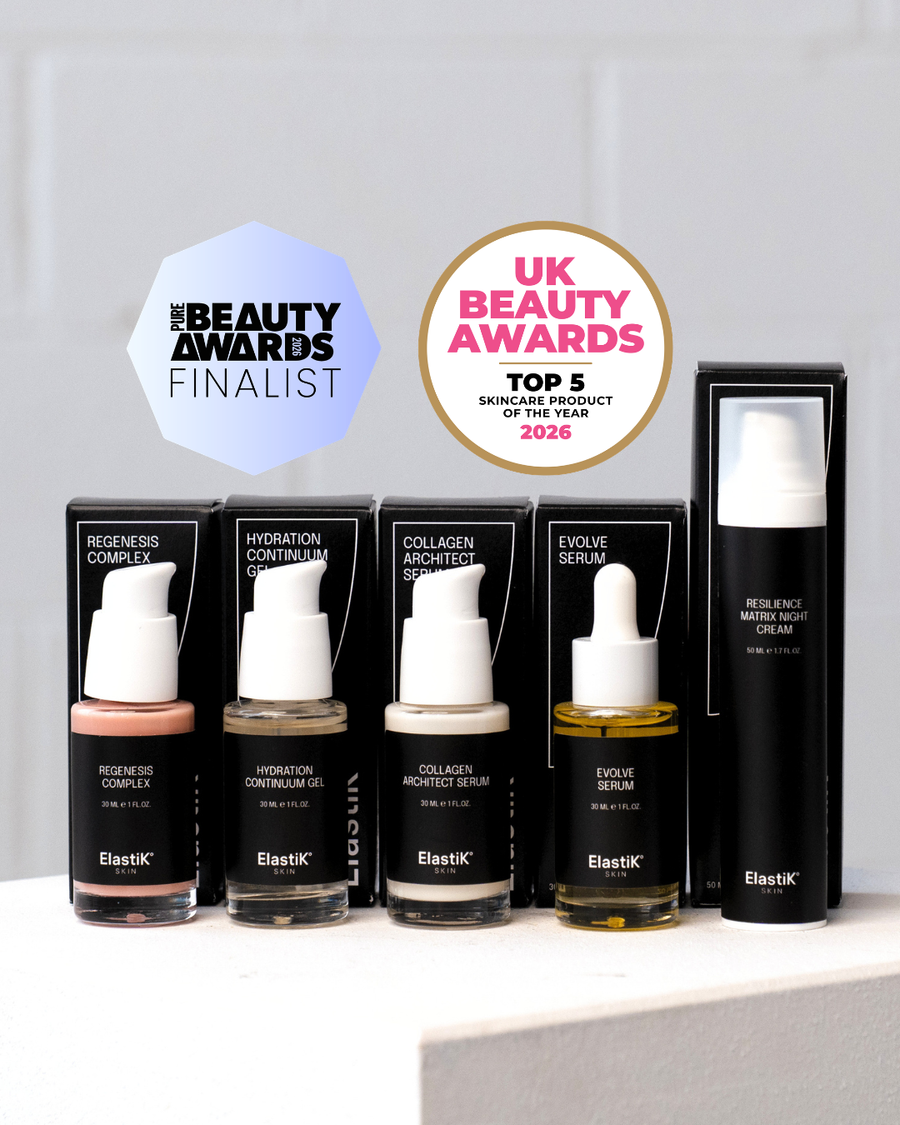
HYDRATION CONTINUUM GEL
Hyaluronic acid with sodium PCA and aloe, straight after your morning shower on the face, neck, décolletage and arms, or anywhere skin feels tight. Quick to apply when time is short.
After birth, time is short and skin often feels tight and dry. A light gel on slightly damp skin takes seconds, and gives you a first layer of hydration before anything else goes on.

COLLAGEN ARCHITECT SERUM
Multi-weight hyaluronic acid and sodium PCA to support the look of firmer, more hydrated skin. Use on the face and neck, and on the abdomen if that is your focus.
The tummy is usually the area that stretched the most.4 This is a lightweight, silky serum that can go on the abdomen as well as the face and neck, and it absorbs quickly so you can get dressed and get on with the day.

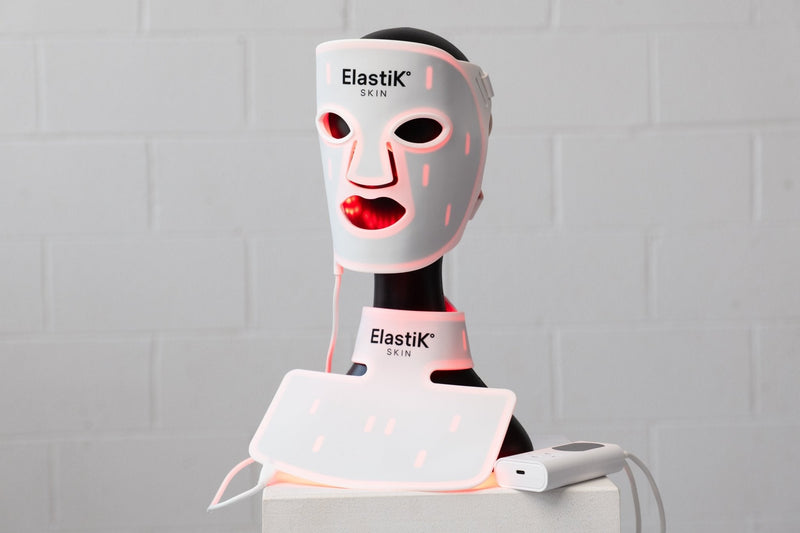
ELASTIK° SKIN LED FACE + NECK MASK
234 LEDs across the face and neck, on clean, dry skin before your evening skincare. Start at 5 minutes and build to 10. UK delivery only.
It is not for use during pregnancy. It is for the face and neck only, so it does nothing for the tummy, but some women add it once their baby has arrived. If you are breastfeeding, check with your midwife or GP before you start using it, as with any new product.

REGENESIS COMPLEX
A peptide serum with hexapeptide-11 and dipalmitoyl hydroxyproline, made for the body as well as the face. A small amount on the stomach each evening.
It is made for the body, so the stomach, where skin often looks soft and creased after birth, gets the same care as the face. If you are breastfeeding, show the ingredient list to your midwife, GP or pharmacist before you start.7

EVOLVE SERUM
Bakuchiol with rosehip, evening primrose and jojoba oils, after Regenesis Complex, for skin that looks uneven or textured, including areas with stretch marks.
Stretch marks usually fade but may not disappear, and prescription retinoid creams should not be used in pregnancy.3 Evolve uses bakuchiol, a plant ingredient that is not a retinoid, in a nourishing oil. Please still check it with your midwife or GP while breastfeeding.

RESILIENCE MATRIX NIGHT CREAM
Shea and cocoa butter with plant glycosphingolipids for the face, neck and décolletage, as you get into bed.
When sleep is broken, the routine is often the first thing to go. This is one simple step as you get into bed, with rich butters that keep skin comfortable overnight.
In our pre-launch trial of the topical routine, all 11 participants said their skin felt more hydrated after six weeks, and 9 of 11 said it felt more comfortable (see the evidence).
06. FAQ
WILL MY LOOSE SKIN GO BACK AFTER PREGNANCY?
Often it improves a lot over the first year, but how much depends on how far it stretched, genetics, age and weight change. Some looseness may remain. That is common, and it is not a failure.
HOW DO I KNOW IF I HAVE DIASTASIS RECTI?
Lie on your back, knees bent, lift your shoulders slightly and feel for a gap above and below your belly button. If it is still obvious at eight weeks after birth, contact your GP.1
CAN CREAMS TIGHTEN LOOSE SKIN AFTER PREGNANCY?
No cream tightens skin or removes stretch marks.3,5 Good skincare helps it feel more comfortable and look smoother and more even.
IS IT SAFE TO USE SKINCARE WHILE BREASTFEEDING?
Many products are fine, but check new active ingredients with your midwife, GP or pharmacist first, as the NHS advises for medicines.7 It also makes sense to keep products away from the nipple area.
WHEN CAN I START EXERCISING AFTER GIVING BIRTH?
After an uncomplicated birth, gentle exercise when you feel ready; get advice at your six-week check before high-impact exercise.6 Avoid sit-ups and planks until you know whether your muscles have separated.1
CAN I GET A TUMMY TUCK ON THE NHS?
Usually not. It is classed as cosmetic surgery.8 If separated muscles are causing pain or problems, start with your GP and a physiotherapist.
RELATED ARTICLES FROM THE SKIN JOURNAL
SOURCES
All sources checked in October 2026.
-
NHS. Your post-pregnancy body. NHS website, last reviewed 20 July 2026.
Read the source on NHS.uk -
Sperstad JB, Tennfjord MK, Hilde G, Ellström-Engh M, Bø K. Diastasis recti abdominis during pregnancy and 12 months after childbirth: prevalence, risk factors and report of lumbopelvic pain. British Journal of Sports Medicine, 2016;50(17):1092–1096.
Read the source -
NHS. Stretch marks. NHS website, last reviewed 30 April 2024.
Read the source on NHS.uk -
Wang F, Calderone K, Do TT, et al. Severe disruption and disorganization of dermal collagen fibrils in early striae gravidarum. British Journal of Dermatology, 2018;178(3):749–760.
Read the source -
Brennan M, Young G, Devane D. Topical preparations for preventing stretch marks in pregnancy. Cochrane Database of Systematic Reviews, 2012;(11):CD000066.
Read the source on the Cochrane Library -
NHS. Keeping fit and healthy with a baby. NHS website, last reviewed 20 April 2026.
Read the source on NHS.uk -
NHS. Breastfeeding and medicines. NHS website, last reviewed 7 May 2026.
Read the source on NHS.uk -
NHS. Tummy tuck (abdominoplasty). NHS website, last reviewed 29 September 2023.
Read the source on NHS.uk
This article is general information, not medical advice. ElastiK° products are cosmetics and support the appearance of skin; they do not treat medical conditions.